2026-02-12 上智大学
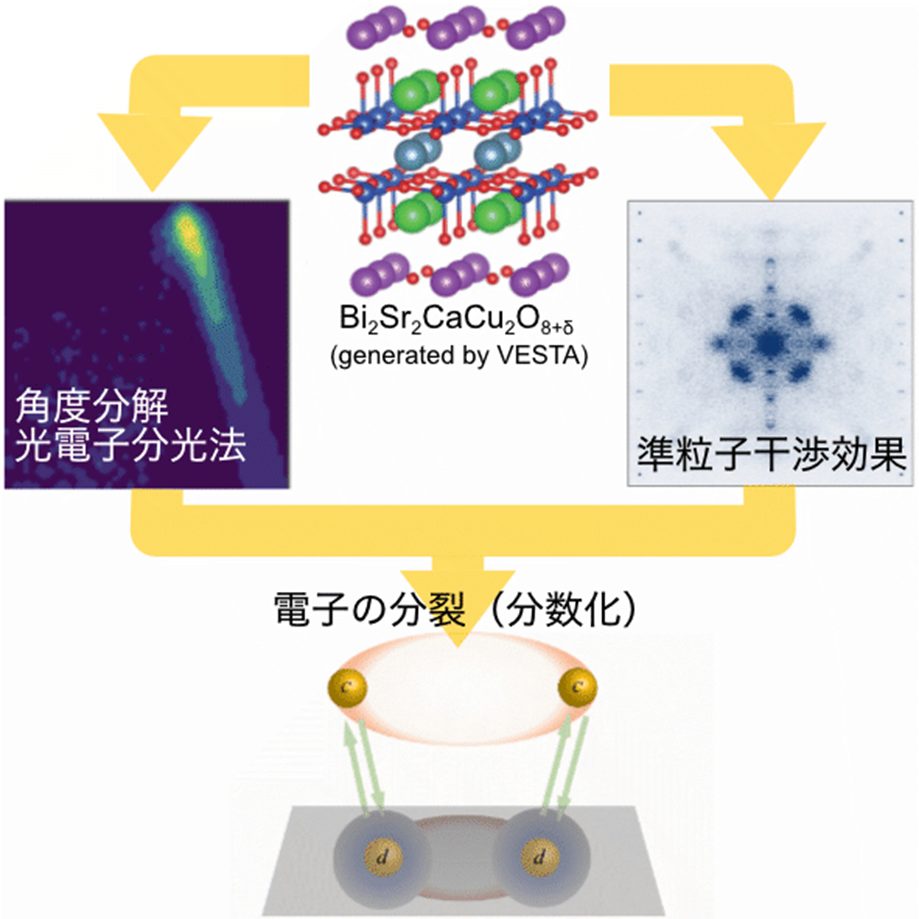
本研究の概略。銅酸化物Bi2Sr2CaCu2O8+δについて測定された角度分解光電子分光法及び準粒子干渉効果の実験データを統合解析し、高温超伝導の鍵となる電子の分数化の実験的証拠を得た。
<関連情報>
- https://www.sophia.ac.jp/jpn/article/news/release/260212_phy/
- https://journals.aps.org/prx/abstract/10.1103/mww7-32gn
光電子スペクトルと準粒子干渉の統合解析から得られる分数電子による銅酸化物超伝導体の統一的記述 Unified Description of Cuprate Superconductors by Fractionalized Electrons Emerging from Integrated Analyses of Photoemission Spectra and Quasiparticle Interference
Shiro Sakai, Youhei Yamaji, Fumihiro Imoto, Tsuyoshi Tamegai, Adam Kaminski, Takeshi Kondo, Yuhki Kohsaka, Tetsuo Hanaguri, and Masatoshi Imada
Physical Review X Published: 4 February, 2026
DOI: https://doi.org/10.1103/mww7-32gn
Abstract
Electronic structure of high-temperature superconducting cuprates is studied by analyzing experimental data independently obtained from two complementary spectroscopies: one, quasiparticle interference (QPI) measured by scanning-tunneling microscopy, and the other, angle-resolved photoemission spectroscopy (ARPES). We combine these two sets of data in a unified theoretical analysis. Through explicit calculations of experimentally measurable quantities, we show that a simple two-component fermion model (TCFM) representing electron fractionalization succeeds in reproducing various detailed features of these experimental data: ARPES and QPI data are concomitantly reproduced by the TCFM in full energy and momentum spaces. The measured QPI pattern reveals a signature characteristic of the TCFM, distinct from the conventional single-component prediction, supporting the validity of the electron fractionalization in the cuprates. The integrated analysis also solves the puzzles of ARPES and QPI data that are seemingly inconsistent with each other. The overall success of the TCFM offers a comprehensive understanding of the electronic structure of the cuprates, in particular, the unoccupied side of the spectra, of which momentum-resolved structure has long been unexplored experimentally. We further predict that a characteristic QPI pattern should appear in the unoccupied high-energy part if the fractionalization is at work. We propose that integrated-spectroscopy analyses offer a promising way to explore challenging issues of strongly correlated electron systems.