
2026-02-06 ワシントン大学セントルイス校
<関連情報>
- https://source.washu.edu/2026/02/making-hydrogen-fuel-cells-less-precious/
- https://www.nature.com/articles/s41929-026-01482-2
現場ガス沈着を制御し、高耐久性Fe-N-C酸素還元燃料電池触媒を構築する Regulating in situ gaseous deposition to construct highly durable Fe–N–C oxygen-reduction fuel cell catalysts
Yachao Zeng,Manman Qi,Jiashun Liang,Raphael P. Hermann,Haoran Yu,Michael J. Zachman,Chun-Wai Chang,Marcos Lucero,Zhenxing Feng,David A. Cullen,Deborah J. Myers,Jean-Pol Dodelet & Gang Wu
Nature Catalysis Published:06 February 2026
DOI:https://doi.org/10.1038/s41929-026-01482-2
Abstract
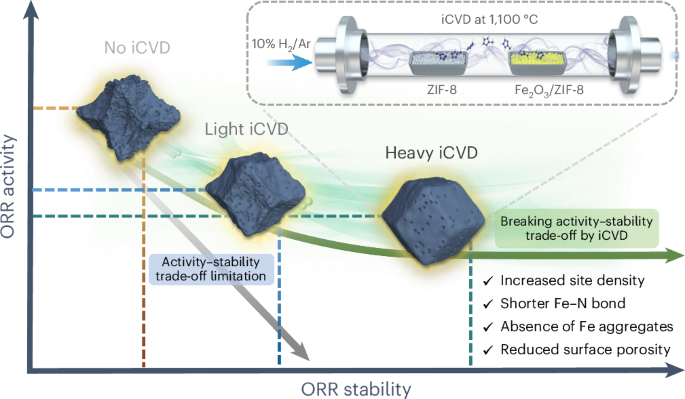
The activity–stability trade-off challenges the design of high-performance atomically dispersed iron–nitrogen–carbon (Fe–N–C) catalysts for the acidic oxygen reduction reaction in polymer electrolyte fuel cells. Here we develop an in situ chemical vapour deposition approach during catalyst synthesis to break the trade-off, producing highly stable Fe–N–C catalysts while maintaining adequate oxygen reduction reaction activity. The optimal catalyst exhibits a half-wave potential of 0.867 V, remaining unchanged after an accelerated stress test (AST) of 100,000 potential cycles in rotating disk electrode tests. In membrane electrode assemblies under H2–air conditions, it delivers 93 mA cm−2 at 0.8 V after a standard AST of 30,000 voltage cycles, and shows minimal current density losses (2.9% at 0.6 V; 14.2% at 0.7 V) after an extended AST up to 120,000 cycles. The catalyst’s durability improvement is primarily due to the in situ chemical vapour deposition, which strengthens Fe–N bonds, increases active-site density, mitigates iron aggregates and reduces surface porosity.
