2026-01-30 九州大学
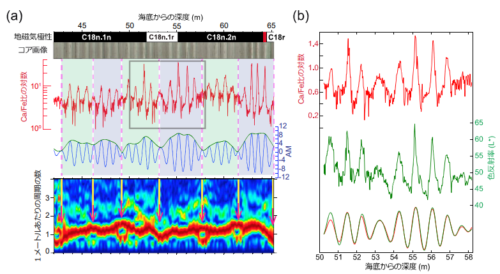
図 1 IODP Site U1408 堆積物コアの統合層序データ
<関連情報>
- https://www.kyushu-u.ac.jp/ja/researches/view/1408
- https://www.kyushu-u.ac.jp/f/64679/26_0130_03.pdf
- https://www.nature.com/articles/s43247-026-03205-8
始新世の地磁気極性逆転の異常に長い期間 Extraordinarily long duration of Eocene geomagnetic polarity reversals
Yuhji Yamamoto,Slah Boulila,Futoshi Takahashi & Peter C. Lippert
Communications Earth & Environment Published:20 January 2026
DOI:https://doi.org/10.1038/s43247-026-03205-8 An unedited version of this manuscript
Abstract
One of the most intriguing attributes of Earth’s magnetic field is that it reverses polarity. Previous palaeomagnetic records mainly from the last ~17 million years indicate that the reversal process typically occurs over ten thousand or fewer years. Here we present an exceptionally resolved deep sea sedimentary palaeomagnetic record that captures two polarity transitions that occurred ~40 million years ago. These transitions occur over 18 and 70 thousand years and are much longer than the typical 10 kyr duration for younger reversals. Longer-duration transitions like these are calculated in numerical geodynamo models, suggesting that variable reversal durations are an intrinsic property of the geodynamo. This variability predicts that polarity transition durations can be much longer than 10 kyr. Occasional prolonged intervals of transitional, and weaker, geomagnetic fields would have exposed Earth’s Eocene environments to greater high-energy radiation from the sun for longer intervals of time, with potential impacts on biota.