2026-01-29 中国科学院(CAS)
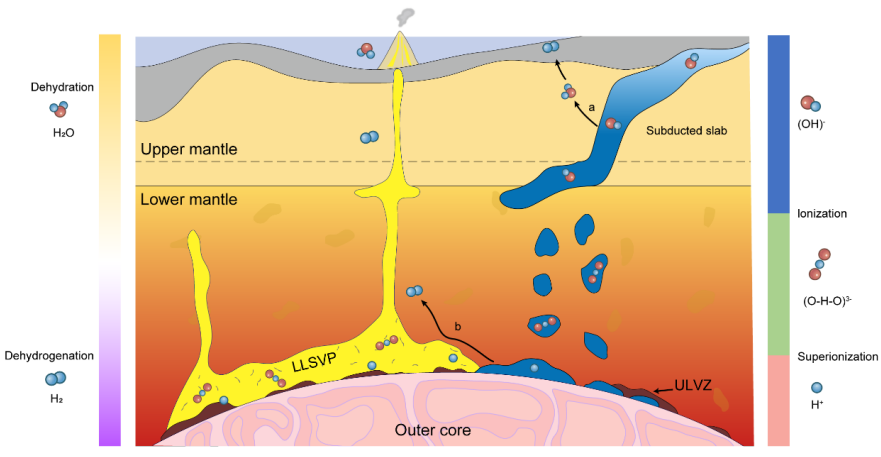
Deep water reservoir and circulation. (Image by IGCAS)
<関連情報>
- https://english.cas.cn/newsroom/research-news/202602/t20260210_1150371.shtml
- https://www.science.org/doi/10.1126/sciadv.aeb3006
地球の核マントル境界における超イオン遷移による脱水の欠如 Absence of dehydration due to superionic transition at Earth’s core-mantle boundary
Yu He, Wei Zhang, Qingyang Hu, Shichuan Sun, […] , and Ho-kwang Mao
Science Advances Published:28 Jan 2026
DOI:https://doi.org/10.1126/sciadv.aeb3006
Abstract
The properties and stability of hydrous phases are crucial to unraveling the mysteries of the deep water cycle. Under deep lower mantle conditions, water and hydrous phases transition into a superionic state. However, superionic effect on their stability and dehydration behavior remains unclear. Using ab initio and deep learning potential molecular dynamics simulations, we discovered a doubly superionic transition in δ-AlOOH, characterized by the highly diffusive behavior of both hydrogen and aluminum ions within the oxygen sublattice. These highly diffusive elements contribute external entropy to the system, stabilizing the structure at 140 GPa and 3800 K. Our free-energy calculations reveal that water tends to freeze under deep lower mantle conditions, so dehydration becomes energetically and kinetically unfavorable even under core-mantle boundary (CMB) conditions. This implies that superionic water may accumulate in the deep lower mantle over geologic time, forming a long-term reservoir at the base of the mantle.
](https://tiisys.com/wp-content/uploads/2026/01/スクリーンショット-2026-01-29-170349.png "法人所属 イームズロボティクスUAV-E6150FA(無人航空機、マルチローター)の事故[無人航空機による人の死傷(重傷)](福島県南相馬市、令和6年6月21日発生)")