2026-01-28 コロンビア大学
<関連情報>
- https://quantum.columbia.edu/news/superfluids-are-supposed-flow-indefinitely-physicists-just-watched-one-stop-moving
- https://www.nature.com/articles/s41586-025-09986-w
二層励起子の超流動から絶縁体への転移の観測 Observation of a superfluid-to-insulator transition of bilayer excitons
Yihang Zeng,Dihao Sun,Naiyuan J. Zhang,Ron Q. Nguyen,Qianhui Shi,A. Okounkova,K. Watanabe,T. Taniguchi,J. Hone,C. R. Dean & J. I. A. Li
Nature Published:28 January 2026
DOI:https://doi.org/10.1038/s41586-025-09986-w
Abstract
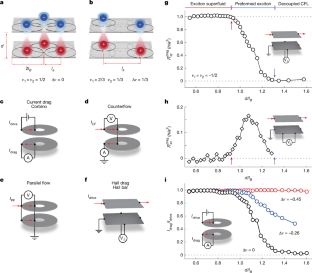
One of the most remarkable properties associated with Bose–Einstein condensation (BEC) is superfluidity, in which the system exhibits zero viscosity and flows without dissipation. The superfluid phase has been observed in wide-ranging bosonic systems spanning naturally occurring quantum fluids, such as liquid helium, to engineered platforms such as bilayer excitons and cold atom systems1,2,3,4. Theoretical works have proposed that interactions could drive the BEC ground state into another exotic phase that simultaneously exhibits properties of both a crystalline solid and a superfluid—termed a supersolid5,6,7,8. Identifying a material system, however, that hosts the predicted BEC solid phase, driven purely by interactions and without imposing an external lattice potential, has remained unknown9,10,11. Here we report observation of a superfluid-to-insulator transition in the layer-imbalanced regime of bilayer magnetoexcitons. Mapping the transport behaviour of the bilayer condensate as a function of density and temperature suggests that the insulating phase is an ordered state of dilute excitons, stabilized by dipole interactions. The insulator melts into a recovered superfluid on increasing the temperature, which could indicate that the low-temperature solid is also a quantum coherent phase.