2026-01-27 ワシントン州立大学(WSU)
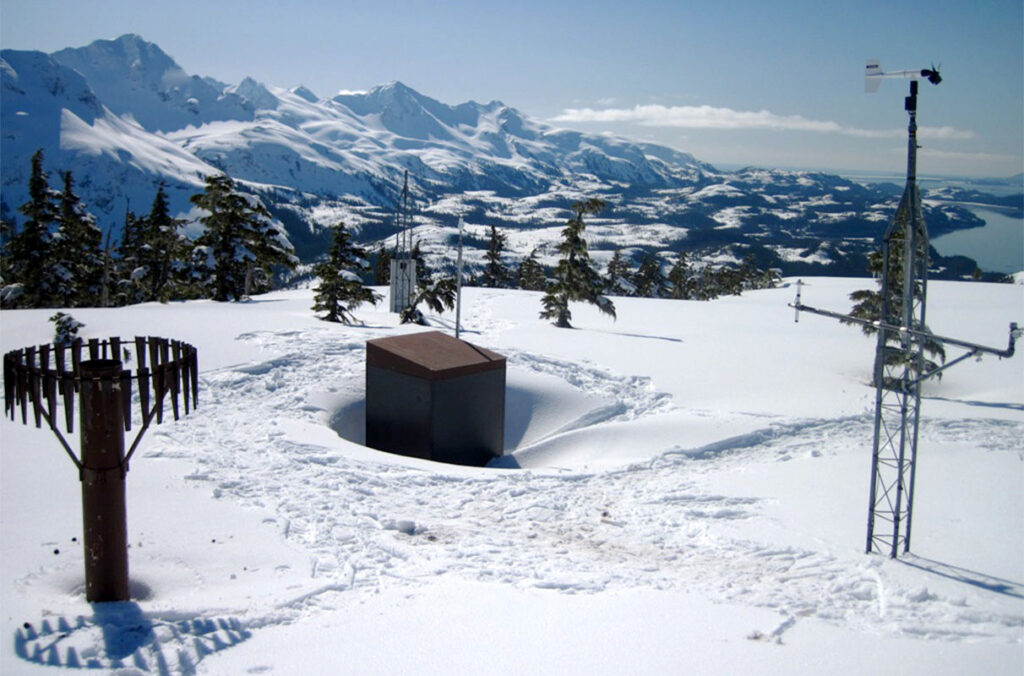
A snow monitoring station on Mount Eyak, above the coastal town of Cordova, Alaska (photo by Daniel Fisher, USDA).
<関連情報>
- https://news.wsu.edu/press-release/2026/01/27/mountain-snow-and-water-forecasting-tool-developed-by-wsu-researchers/
- https://arxiv.org/abs/2511.08856
- https://arxiv.org/pdf/2511.08856
ForeSWE: 不確実性を考慮した注意モデルによる積雪水量当量の予測 ForeSWE: Forecasting Snow-Water Equivalent with an Uncertainty-Aware Attention Model
Krishu K Thapa, Supriya Savalkar, Bhupinderjeet Singh, Trong Nghia Hoang, Kirti Rajagopalan, Ananth Kalyanaraman
arXiv Submitted on 12 Nov 2025
DOI:https://doi.org/10.48550/arXiv.2511.08856
Abstract
Various complex water management decisions are made in snow-dominant watersheds with the knowledge of Snow-Water Equivalent (SWE) — a key measure widely used to estimate the water content of a snowpack. However, forecasting SWE is challenging because SWE is influenced by various factors including topography and an array of environmental conditions, and has therefore been observed to be spatio-temporally variable. Classical approaches to SWE forecasting have not adequately utilized these spatial/temporal correlations, nor do they provide uncertainty estimates — which can be of significant value to the decision maker. In this paper, we present ForeSWE, a new probabilistic spatio-temporal forecasting model that integrates deep learning and classical probabilistic techniques. The resulting model features a combination of an attention mechanism to integrate spatiotemporal features and interactions, alongside a Gaussian process module that provides principled quantification of prediction uncertainty. We evaluate the model on data from 512 Snow Telemetry (SNOTEL) stations in the Western US. The results show significant improvements in both forecasting accuracy and prediction interval compared to existing approaches. The results also serve to highlight the efficacy in uncertainty estimates between different approaches. Collectively, these findings have provided a platform for deployment and feedback by the water management community.