2026-01-26 カリフォルニア大学リバーサイド校(UCR)
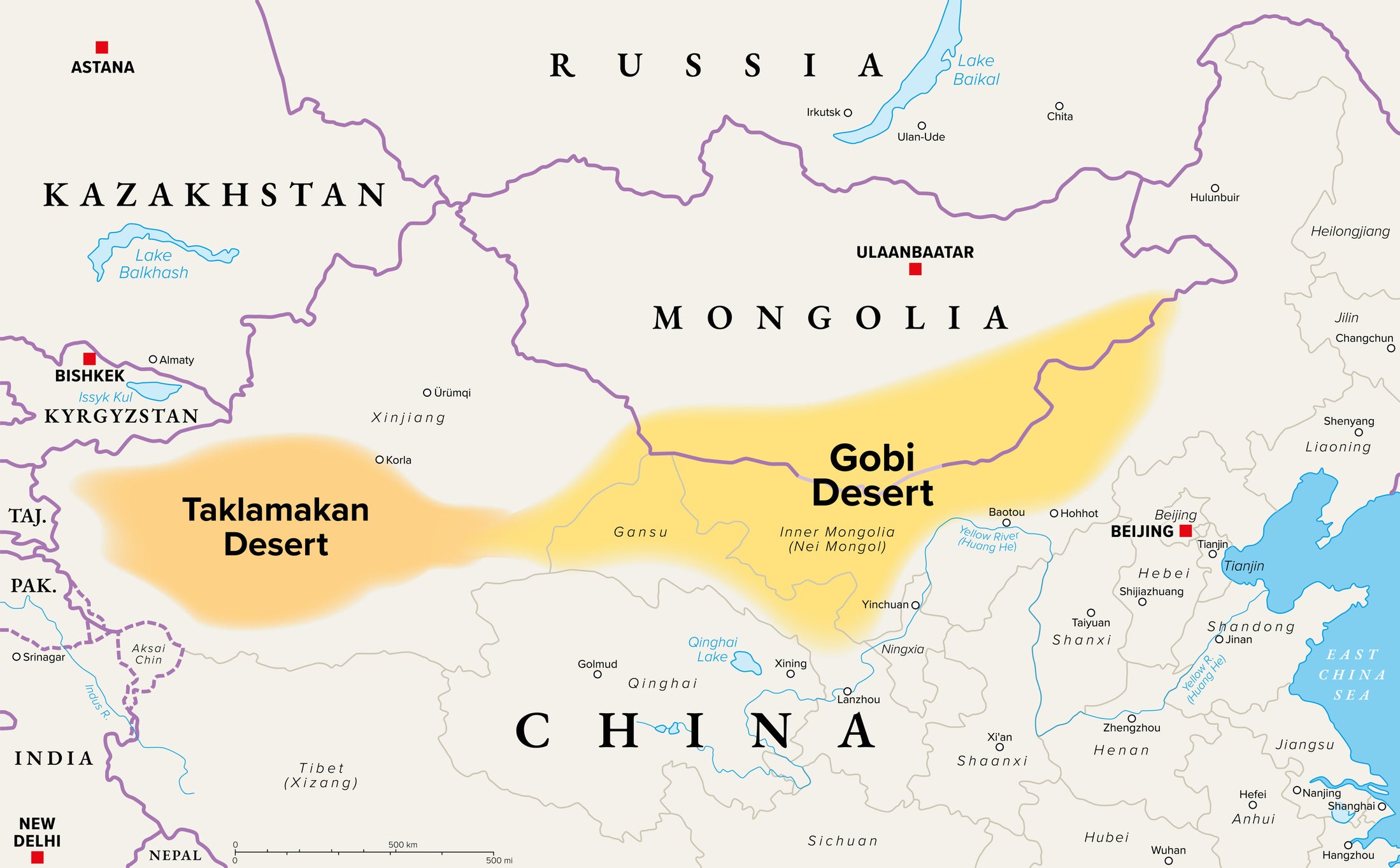
Taklamakan Desert location. (PeterHermesFurian/iStock/Getty)
<関連情報>
- https://news.ucr.edu/articles/2026/01/26/shrubs-curb-carbon-emissions-chinas-largest-desert
- https://www.pnas.org/doi/10.1073/pnas.2523388123
人為的生物圏炭素吸収源:タクラマカン植林プロジェクトの影響 Human-induced biospheric carbon sink: Impact from the Taklamakan Afforestation Project
Salma Noor, Xun Jiang, Xinyue Wang, +6 , and Yuk L. Yung
Proceedings of the National Academy of Sciences Published:January 20, 2026
DOI:https://doi.org/10.1073/pnas.2523388123
Significance
This study highlights the Taklamakan Desert’s emerging and previously underappreciated role in the global carbon cycle. By revealing how human-led afforestation can transform hyperarid landscapes into functioning carbon sinks, it demonstrates that even the most extreme deserts are not beyond ecological recovery and can be managed for carbon storage, thus helping to mitigate climate change. The observed greening trend suggests a significant climate impact, as increased CO2 uptake in arid zones could influence regional and even global climate dynamics. This work provides critical constraints and benchmarks for refining Earth system models and supports the development of more effective carbon management strategies, particularly in dryland regions that have long been overlooked in global reforestation and carbon removal efforts.
Abstract
The Taklamakan Desert, one of the world’s largest and driest deserts, has traditionally been considered a biological void. Here, we demonstrate that large-scale ecological restoration is transforming this hyperarid environment into a carbon sink. By analyzing satellite and ground-based data, we find strong seasonal dynamics: During the wet season (Jul to Sep), precipitation increases to 16.3 mm/mo, enhancing vegetation coverage and photosynthetic activity and drawing down atmospheric CO2 by approximately three parts per million (ppm) relative to the dry-season levels. Long-term trends reveal significant increases in vegetation cover (6.8 × 10⁻⁴/y) and photosynthetic activity (6.1 × 10⁻³ W/m2/sr/µm/y), accompanied by a strengthening net CO2 uptake (NEE trend: −5.2 × 10⁻¹² kg/m2/s/y). These changes are spatially concentrated along the desert margins and their timing aligns with implementation of China’s Three-North Shelterbelt Program. Our results provide the direct evidence that human-led intervention can effectively enhance carbon sequestration in even the most extreme arid landscapes, demonstrating the potential to transform a desert into a carbon sink and halt desertification. This underscores the critical role of dryland restoration in global carbon management strategies and highlights the Taklamakan Desert as a model for climate change mitigation through nature-based solutions and ecological engineering.