2026-01-16 イリノイ大学
<関連情報>
- https://aces.illinois.edu/news/illinois-researchers-untangle-drivers-nitrogen-loss-upper-mississippi-river-basin
- https://pubs.acs.org/doi/10.1021/acs.est.5c06476
水文学的変動と人間の活動は、ミシシッピ川上流域における河川窒素輸出の時空間的変化をどのように制御するのか? How do Hydrological Variability and Human Activities Control the Spatiotemporal Changes of Riverine Nitrogen Export in the Upper Mississippi River Basin?
Qianyu Zhao,Bin Peng,Zewei Ma,Mengqi Jia,Gregory F. McIsaac,Dale M. Robertson,David A. Saad,Richard E. Warner,Xiaocui Wu,Qu Zhou,and Kaiyu Guan
Environmental Science & technology Published December 20, 2025
DOI:https://doi.org/10.1021/acs.est.5c06476
Abstract
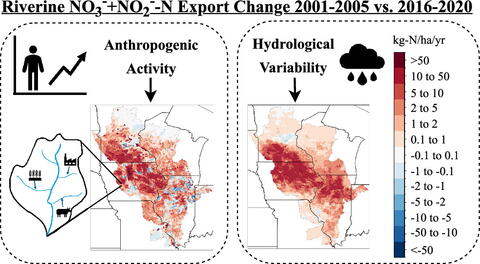
Excessive nitrogen export from agricultural watersheds remains a critical water quality challenge, with the Upper Mississippi River Basin (UMRB) significantly contributing to downstream eutrophication and hypoxia in the Gulf. This study investigates the spatiotemporal dynamics of riverine nitrate plus nitrite (NO3– + NO2–-N) export across the UMRB at high spatial resolution (12-digit Hydrologic Unit Codes or HUC12 subwatershed scale) during 2001–2020 and quantifies the effects of anthropogenic activities and hydrological variability on riverine NO3– + NO2–-N export changes in the region between 2001–2005 and 2016–2020. Our results revealed hotspots of substantial increases in NO3– + NO2–-N yields across the UMRB, with distinct regional patterns in driving factors. Over the entire UMRB, NO3– + NO2–-N yields increased by 9.7 kg/ha/yr on average from 2001–2005 to 2016–2020, with anthropogenic activities contributing 4.8 kg/ha/yr and hydrological variability contributing 4.9 kg/ha/yr. The northern and western UMRB had combined influences from both anthropogenic activities and hydrological variability, while the east-central regions had predominantly hydrologically driven changes. Agricultural sources, including fertilizer, manure, and biological nitrogen fixation, collectively contributed over 80% of NO3– + NO2–-N loading throughout the basin. This framework for disentangling human and hydrological impacts provides critical insights for developing effective and targeted watershed management strategies to reduce nutrient losses and improve water quality.