2026-01-14 カーディフ大学
<関連情報>
- https://www.cardiff.ac.uk/news/view/3003917-woolly-rhino-genes-recovered-from-ice-age-wolf-stomach
- https://academic.oup.com/gbe/article/18/1/evaf239/8414728
絶滅危惧種のケナガサイのゲノム解析で近親交配の痕跡なし、古代オオカミの胃からサンプル発見 Genome Shows no Recent Inbreeding in Near-Extinction Woolly Rhinoceros Sample Found in Ancient Wolf’s Stomach
Sólveig M Guðjónsdóttir,Edana Lord,Zoé Pochon,Špela Lemež,Nicolas Dussex,David W G Stanton,Mikkel-Holger S Sinding,Sergey Fedorov,Love Dalén,J Camilo Chacón-Duque
Genome Biology and Evolution Published:14 January 2026
DOI:https://doi.org/10.1093/gbe/evaf239
Abstract
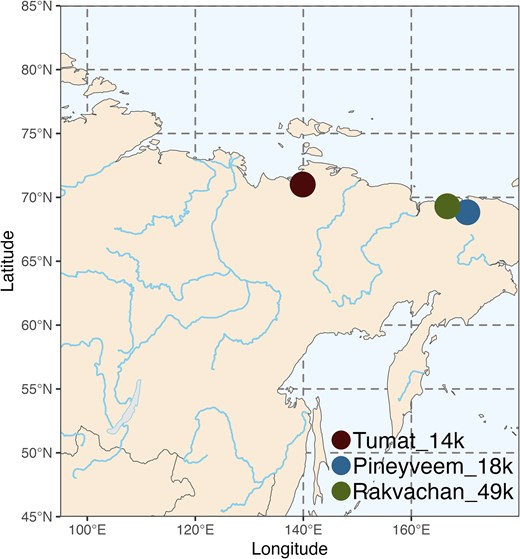
Using temporarily spaced high-coverage ancient genomes, we can assess population decline prior to extinction. However, finding suitable ancient remains for recovering this type of data is challenging. Here, we sequenced a high-coverage genome from muscle tissue of a 14,400-year-old woolly rhinoceros (Coelodonta antiquitatis)—a cold-adapted herbivore that went extinct ∼14,000-years ago—found inside a permafrost-preserved wolf’s stomach. We compared genome-wide diversity, inbreeding, genetic load, and population size changes in this sample with two other Late Pleistocene Siberian woolly rhinoceros. We found no evidence of population size decline, nor any genomic erosion, shortly prior to the species’ demise. Given the few long homozygous segments, typically indicative of recent inbreeding, we infer a stable population size only a few centuries before extinction. Thus, the woolly rhinoceros’ extinction likely happened rapidly, during the Bølling–Allerød interstadial. This study demonstrates the ability to recover high-quality DNA from unlikely sources to elucidate species’ extinction dynamics.