2026-01-12 カリフォルニア大学リバーサイド校(UCR)
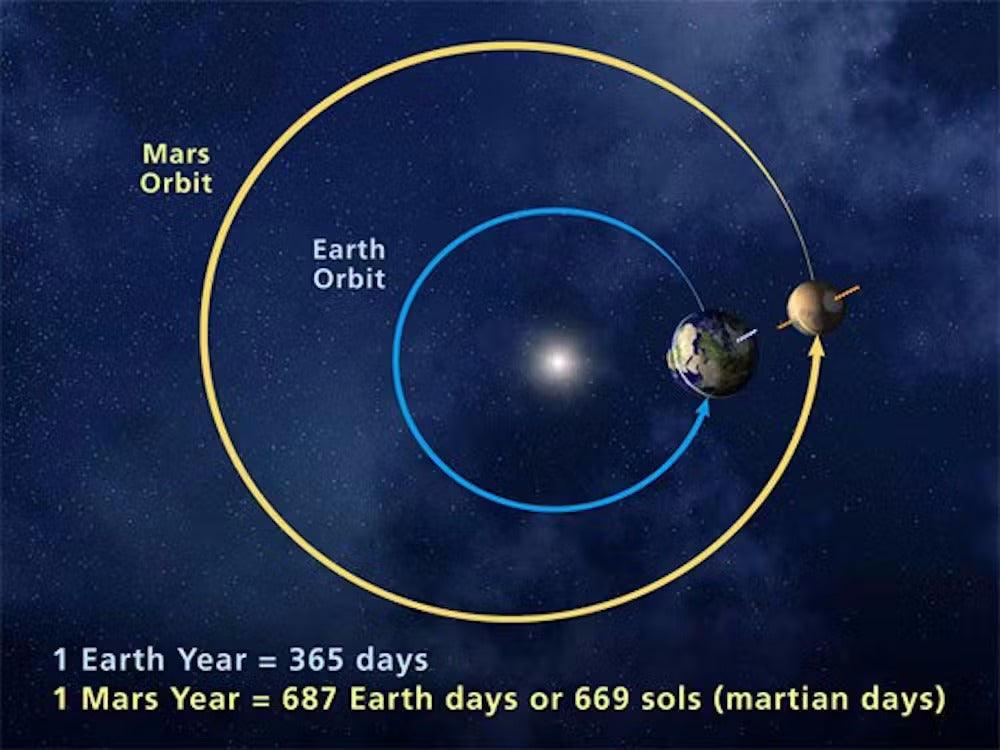
Differences in the way Earth and Mars orbit the sun. (NASA)
<関連情報>
- https://news.ucr.edu/articles/2026/01/12/tiny-mars-big-impact-earths-climate
- https://iopscience.iop.org/article/10.1088/1538-3873/ae2800
地球ミランコビッチサイクルの火星質量への依存 The Dependence of Earth Milankovitch Cycles on Martian Mass
Stephen R. Kane, Pam Vervoort, and Jonathan Horner
Publications of the Astronomical Society of the Pacific Published: 2025 December 18
DOI:10.1088/1538-3873/ae2800
Abstract
The Milankovitch cycles of Earth result from gravitational interactions with other bodies in the solar system. These interactions lead to slow changes in the orbit and angular momentum vector of Earth, and correspondingly influence Earth’s climate evolution. Several studies have shown that Mars may play a significant role in these Milankovitch cycles, such as the 2.4 Myr eccentricity cycle related to perihelion precession dynamics. Here we provide the results of a detailed dynamical analysis that explores the Earth Milankovitch cycles as a function of the Martian mass to quantify the extent that Mars influences variations in Earth’s orbital eccentricity, the longitude of perihelion, the longitude of the ascending node, and obliquity (axial tilt). Our results show that, although the 405 kyr long-eccentricity metronome driven by g2 (Venus) and g5 (Jupiter) persists at all Mars masses, the ∼100 kyr short-eccentricity bands driven by g4 (Mars) lengthen and gain power as Mars becomes more massive, consistent with enhanced coupling among inner-planet g-modes. The 2.4 Myr grand cycle is absent when Mars approaches zero mass, reflecting the movement of g4 with the Martian mass. Meanwhile, Earth’s obliquity cycles driven by s3 (Earth) and s4 (Mars) lengthen from the canonical ∼41 kyr with increasing Mars mass, relocating to a dominant 45–55 kyr band when the mass of Mars is an order of magnitude larger than its present value. These results establish how Mars’ mass controls the architecture of Earth’s climate-forcing spectrum and that the Milankovitch spectrum of an Earth-like planet is a sensitive, interpretable probe of its planetary neighborhood.