2026-01-04 中国科学院(CAS)
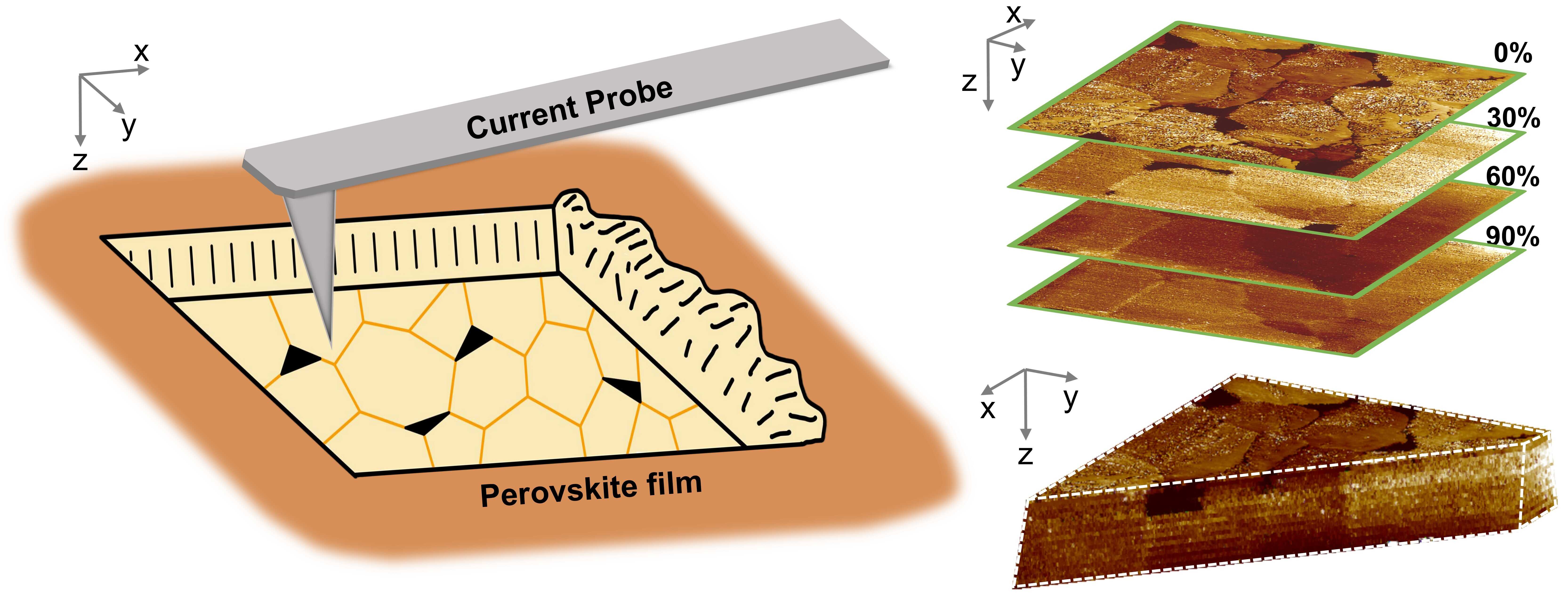
Three-dimensional mapping of electrical behavior in perovskite films. (Image by NIMTE)
<関連情報>
- https://english.cas.cn/newsroom/research-news/202601/t20260104_1145004.shtml
- https://www.cell.com/newton/fulltext/S2950-6360(25)00359-7
トモグラフィー導電性原子間力顕微鏡を用いたペロブスカイト膜の電気的挙動の3次元マッピング Three-dimensional mapping of electrical behavior in perovskite films using tomographic conductive atomic force microscopy
Minghui Li ∙ Pengfei Wu ∙ Jiali Liu ∙ … ∙ Yaxin Zhai ∙ Fei Zhang ∙ Chuanxiao Xiao
Newton Published:December 31, 2025
DOI:https://doi.org/10.1016/j.newton.2025.100367
Accessible overview
Effective passivation treatments are widely used in perovskite solar cells to mitigate defects in perovskite materials. However, current microscopy techniques for assessing passivation effects are often limited to surface analysis. In this study, we use contact-mode tomographic conductive atomic force microscopy to map the current distribution within perovskite films as they are progressively removed. This technique reveals the internal current distribution across perovskite films subjected to various passivation treatments. By reconstructing three-dimensional current images, we generate a current volume, with vertical slices providing detailed insight into the evolution of high-resistance regions within the films. Through quantitative analysis, we compare the internal current distributions and potential defects in untreated, bulk-treated, surface-treated, and combination-treated samples. Comprehensive film and device characterizations further validate the reliability of our method. This work introduces a robust and versatile tool for analyzing passivation effects in perovskite materials, offering opportunities to improve film quality and optimize device performance in perovskite technologies.
Highlights
- TC-AFM maps current in perovskite films at different depths during material removal
- 3D volume reconstruction reveals vertical current variation within the film
- Quantitative analysis shows conductivity differences among passivation treatments
- Multiple characterization methods validate the reliability of proposed technique
Summary
Passivation treatments are crucial for improving the performance of perovskite solar cells by reducing non-radiative recombination and enhancing charge transport. However, their microscopic effects within the perovskite films remain unclear due to limitations of conventional characterization methods. This study uses three-dimensional tomographic conductive atomic force microscopy to examine the structural and electrical properties of perovskite films treated with different passivation strategies. Through 3D current mapping and quantitative analysis, we identify internal electrical pathways and structural defects. While untreated films exhibit high-resistance regions that hinder carrier transport, bulk passivation reduces these regions, particularly in the film interior, thereby enhancing grain boundary conductivity. Surface passivation primarily mitigates near-surface defects, improving local conductivity. Combining both strategies results in a more conductive internal structure, with high-resistance regions confined to the top surface. These findings highlight how passivation treatments improve perovskite film quality, directly correlating with enhanced solar cell performance.