2025-12-24 物質・材料研究機構
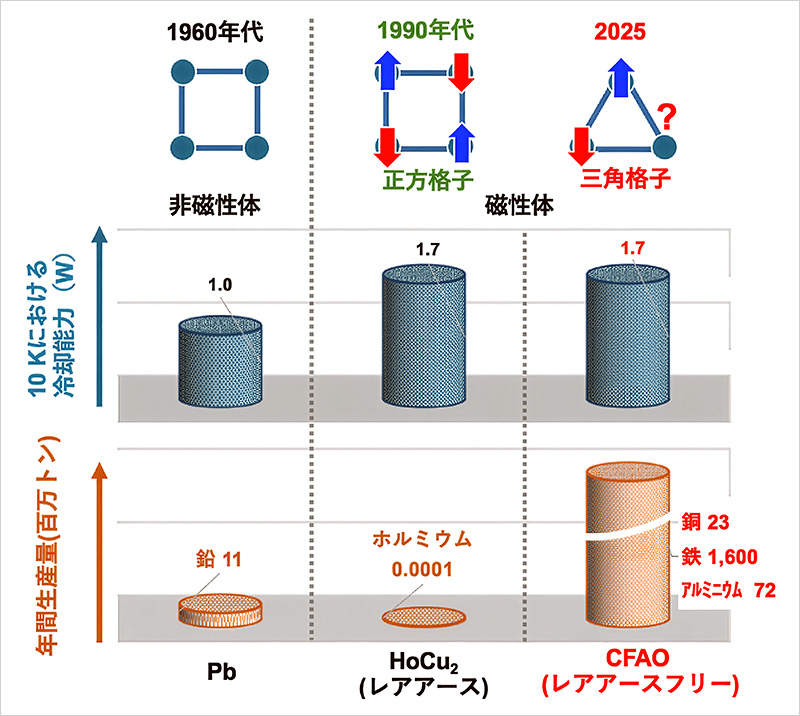
図: 1960年代のGM冷凍機では鉛(Pb)が蓄冷材として用いられていましたが、1990年代にはレアアース金属化合物HoCu2が導入され、冷却性能が大きく向上しました。今回開発したレアアースフリー蓄冷材CuFe0.98Al0.02O2(CFAO)は、これらに匹敵する冷却能力を持ちながら、豊富な元素のみで構成されるため、持続可能で環境負荷の少ない極低温冷却技術につながります。
<関連情報>
- https://www.nims.go.jp/press/2025/12/202512240.html
- https://www.nims.go.jp/press/2025/12/a5kbo7000000d48e-att/202512240.pdf
- https://www.nature.com/articles/s41598-025-29709-5
豊富元素のスピンフラストレーションを利用した革新的な極低温冷却材料 Innovative cryogenic cooling material using spin frustration from abundant elements
Noriki Terada,Hiroaki Mamiya,Akiko T. Saito & Shinji Masuyama
Scientific Reports Published:28 November 2025
DOI:https://doi.org/10.1038/s41598-025-29709-5
Abstract
Cryogenic cooling technology is essential for modern applications, such as magnetic resonance imaging and quantum computing; however, it currently relies heavily on critical resources such as helium and heavy rare-earth elements. As demand for cryogenic cooling increases, developing alternative technologies that reduce reliance on these scarce resources is crucial. This study introduces regenerator materials from abundant elements—copper, iron, and aluminum—that function as Gifford–McMahon (GM) cryocoolers. These materials achieve cryogenic cooling through the spin frustration effect, where competing magnetic interactions enhance magnetic heat capacity. CuFe₁₋ₓAlₓO₂ demonstrates effective cooling capacity at the helium condensation temperature comparable with that of conventional heavy rare-earth-based materials and surpasses the performance specifications of commercial GM cryocoolers. These findings demonstrate the potential of non-rare-earth magnetic materials for sustainable cryogenic technology, reducing dependence on critical resources.