2025-12-23 マサチューセッツ工科大学(MIT)
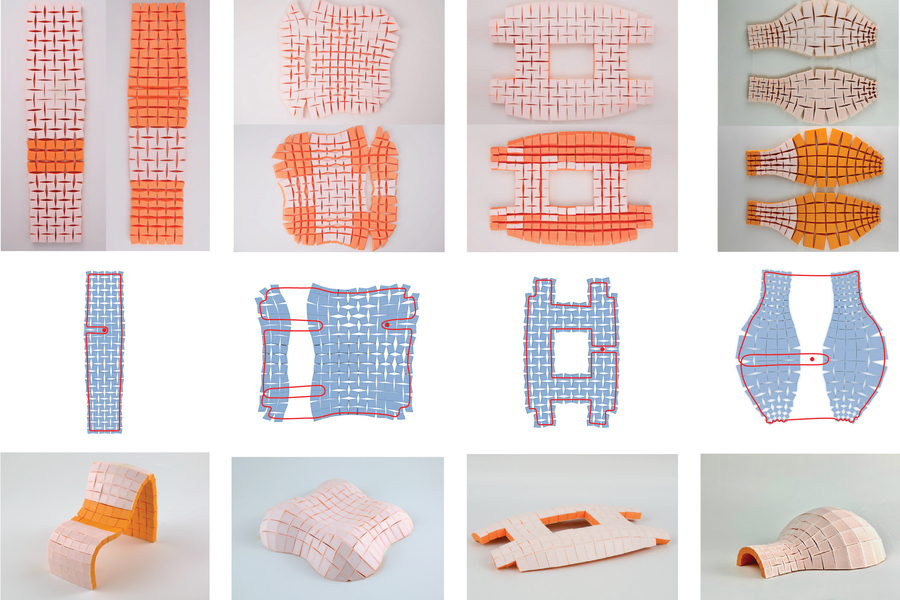 Four 3D structures, pictured on bottom, were transformed from flat configurations made of interconnected tiles (top) with a single pull of a string. The middle row shows, in red, the optimized string path and lift points for each object.Credit: Courtesy of the researchers
<関連情報>
- https://news.mit.edu/2025/one-string-pull-deploys-complex-structures-1223
- https://dl.acm.org/doi/10.1145/3763357
一本の糸で全てを繋ぐ:平面オーセチックリンク機構から曲線構造物を高速に組み立てる One String to Pull Them All: Fast Assembly of Curved Structures from Flat Auxetic Linkages
Akib Zaman, Jacqueline Aslarus, Jiaji Li, Stefanie Mueller, Mina Konakovic Lukovic
ACM Transactions on Graphics Published: 04 December 2025
DOI:https://doi.org/10.1145/3763357
Abstract
We present a computational approach for designing freeform structures that can be rapidly assembled from initially flat configurations by a single string pull. The target structures are decomposed into rigid spatially varied quad tiles that are optimized to approximate the user-provided surface, forming a flat mechanical linkage. Our algorithm then uses a two-step method to find a physically realizable string path that controls only a subset of tiles to smoothly actuate the structure from flat to assembled configuration. We initially compute the minimal subset of tiles that are required to be controlled with the string considering the geometry of the structure and interaction among the tiles. We then find a valid string path through these tiles that minimizes friction, which will assemble the flat linkage into the target 3D structure upon tightening a single string. The resulting designs can be easily manufactured with computational fabrication techniques such as 3D printing, CNC milling, molding, etc. in flat configuration that, in addition to manufacturing, facilitates storage and transportation. We validate our approach by developing a series of physical prototypes and showcasing various application case studies, ranging from medical devices, space shelters, to architectural designs.