2025-12-22 物質・材料研究機構
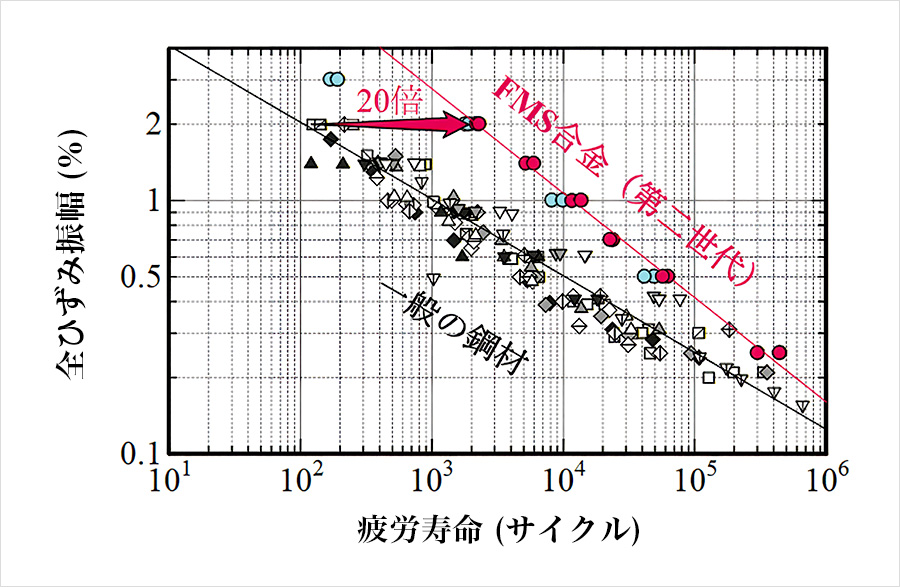
図: 変形の大きさ(全ひずみ振幅)と耐久性(疲労寿命)の関係 : 新鋼材である第二世代FMS合金は優れた耐久性を有する。
<関連情報>
- https://www.nims.go.jp/press/2025/12/202512220.html
- https://www.nims.go.jp/press/2025/12/ui667t000000cz3a-att/202512220.pdf
- https://www.sciencedirect.com/science/article/abs/pii/S0921509325016818
Fe–15Mn–11Cr–7.5Ni–4Si合金の低サイクル疲労と微細組織 Low cycle fatigue and microstructures of Fe–15Mn–11Cr–7.5Ni–4Si alloy
Fumiyoshi Yoshinaka, Takahiro Sawaguchi, Tomoya Nagira, Susumu Takamori, Satoshi Emura, Yasuhiko Inoue
Materials Science and Engineering: A Available online: 19 November 2025
DOI:https://doi.org/10.1016/j.msea.2025.149457
Highlights
- Low cycle fatigue testing and microstructural analysis on Fe–15Mn–11Cr–7.5Ni–4Si.
- It had longer fatigue life than conventional and TRIP/TWIP steels.
- Rapid cyclic hardening was associated with multiple slips in γ-austenite.
- Gradual hardening was linked to sluggish ε-martensite formation until fracture.
- It had both good fatigue durability and reduced risk of solidification cracking.
Abstract
This paper is an investigation of the fatigue behavior and microstructural evolution of Fe–15Mn–11Cr–7.5Ni–4Si (X05) austenitic steel, developed from Fe–15Mn–10Cr–8Ni–4Si (X0) to reduce the risk of solidification cracking. Strain-controlled fatigue tests were conducted at various total strain amplitudes. X05 demonstrated superior fatigue life to conventional steels and transformation/twinning-induced plasticity steels while maintaining performance comparable to X0. Its cyclic hardening behavior consisted of rapid hardening in its early fatigue stages, followed by gradual hardening until fracture. The extent of cyclic hardening became more pronounced with strain amplitudes, with a steeper rise at lower strain amplitudes. Electron backscatter diffraction analysis and ferrite-scope measurements showed that γ→ε martensitic transformation occurred across all strain amplitudes, whereas α′-martensite appeared only at higher amplitudes. The ε-martensite fraction increased with the strain amplitude but saturated at approximately 75 % above a total strain amplitude of 1 %, while the α′-martensite continued to increase at higher strain amplitudes. Interrupted fatigue tests revealed multiple slip activations in γ-austenite in its early fatigue stages, followed by progressive ε-martensite formation until failure. Therefore, the initial rapid hardening was driven by dislocation interactions on multiple slip systems, and its gradual hardening was caused by sluggish ε-martensite formation, resulting in progressive grain refinement. The α′-martensite was not detected during the early stages but started to appear gradually in the later stages of fatigue, following the formation of ε-martensite. These findings confirm that the modification of chemical composition from X0 does not deteriorate fatigue life and does not significantly change cyclic hardening behavior of X05. Furthermore, the cyclic hardening behavior appears to be influenced by dynamic microstructural changes during fatigue deformation, exhibiting a pronounced dependence on strain amplitude.