2025-12-19 立教大学
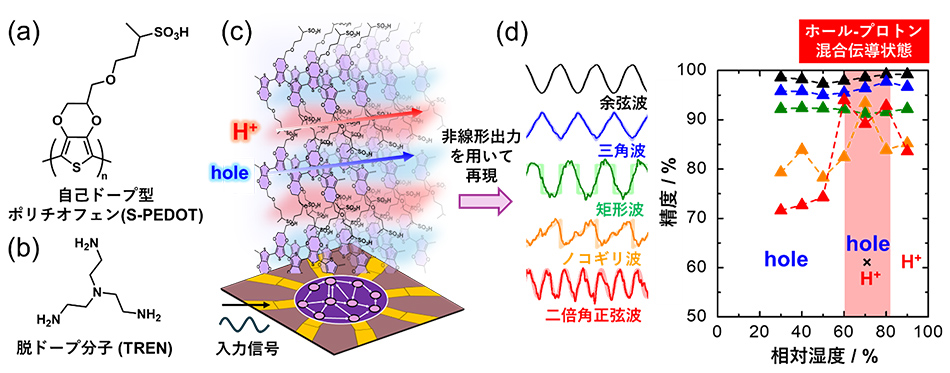
図1.(a)自己ドープ型ポリチオフェン(S-PEDOT)と(b)脱ドープ分子である多価アミンの化学構造、(c)本系におけるホール-プロトン混合伝導状態を示すイメージ図。(d)混合伝導状態を示す条件にてマテリアルリザバー素子の性能(波形生成タスクの精度)が向上することを示す図。
<関連情報>
- https://www.rikkyo.ac.jp/news/2025/12/mknpps000003eefw.html
- https://advanced.onlinelibrary.wiley.com/doi/10.1002/advs.202520270
自己ドープポリ(3,4-エチレンジオキシチオフェン)ナノフィルムの化学的脱ドーピングによって誘起される協同的なプロトン-電子混合伝導を利用した物質内物理リザーバー Utilizing Cooperative Proton–Electron Mixed Conduction Induced via Chemical Dedoping of Self-Doped Poly(3,4-ethylenedioxythiophene) Nanofilms for In-Material Physical Reservoirs
Yuya Ishizaki-Betchaku, Motoaki Onishi, Tomoki Misaka, Mitsuo Hara, Hirokazu Yano, Hidenori Okuzaki, Jun Matsui, Tsuyoshi Hasegawa, Takuya Matsumoto, Hirofumi Tanaka, Shusaku Nagano
Advanced Science Published: 18 December 2025
DOI:https://doi.org/10.1002/advs.202520270
Abstract
In this study, an intrinsic ion–electron (hole) coequally conductive state is introduced, induced by de-doping in self-doped poly(3,4-ethylenedioxythiophene) (S-PEDOT) nanofilms, enhances the performance of in-material physical reservoirs (PRs) through the cooperative utilization of both carriers. A chemical dedoping modulates the electrical characteristics of the S-PEDOT PRs. Impedance spectroscopy under controlled relative humidity (RH) conditions reveals that the predominant conducting carriers of the S-PEDOT nanofilms change systematically depending on the RH. Under low RH, the dominant carriers are holes. At a moderate RH (60–80%), the S-PEDOT nanofilm exhibits a hole–proton mixed conducting state. A further increase in RH leads to predominantly proton carrier conduction. Moreover, the PR performance of the S-PEDOT nanofilms is evaluated by wave generation and nonlinear autoregressive moving average (NARMA) tasks. The S-PEDOT PRs display the best performance at RHs ranging from 60% to 80% (mixed conducting state). Therefore, it is concluded that this high PR performance is attributed to the complex dynamics originating from the cooperative hole–proton mixed conducting state of the S-PEDOT nanofilms. The results obtain in the present study are the first report of PRs using intrinsically ion–electron mixed conducting states, paving the way for the development of high-performance material-based PRs.