2025-09-17 中国科学院(CAS)
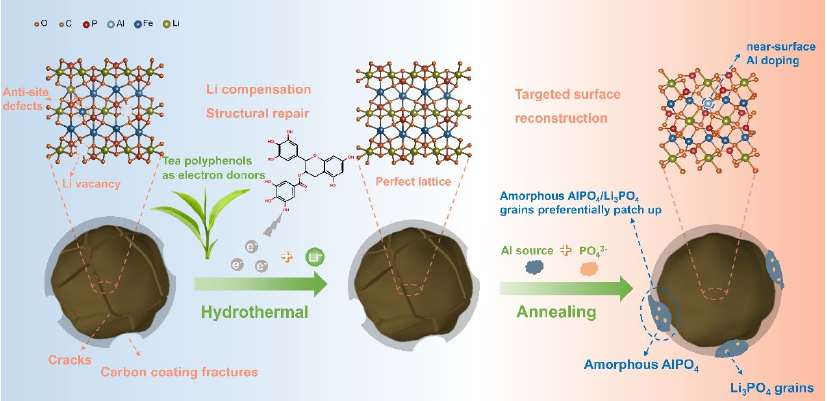
Schematic diagram of direct repair and regeneration mechanism for the retired LiFePO₄ cathodes. (Image by LIU Yuanyuan)
<関連情報>
- https://english.hf.cas.cn/nr/bth/202509/t20250917_1054960.html
- https://advanced.onlinelibrary.wiley.com/doi/10.1002/adma.202511246
天然電子供与体による修復と標的表面再構成による劣化LiFePO 4正極材料の直接リサイクル Direct Recycling of Degraded LiFePO4 Cathode Material via Natural Electron Donors Healing and Targeted Surface Reconstruction
Yuanyuan Liu, Jin Bai, Ruyu Shi, Peiyao Wang, Ke Xiao, Siya Wang, Shiyu Qiu, Xianlong Wang, Xuebin Zhu, Kaishuai Yang, Guangmin Zhou, Bangchuan Zhao, Yuping Sun
Advanced Materials Published: 13 September 2025
DOI:https://doi.org/10.1002/adma.202511246
Abstract
Direct regeneration of spent cathode materials is crucial for the sustainable development of the new energy vehicle industry. However, owing to the lack of targeted surface repair strategies, the regenerated LiFePO4 (LFP) always faces some issues, such as Fe ions re-migration and sluggish Li+ diffusion, or a serious trade-off between restored specific capacity and stability. Herein, an integrated bulk and surface restoration strategy is proposed to regenerate spent LFP (S-LFP) via using natural tea polyphenols as electron donors to reduce Fe (III) phase and heal anti-site defects in the bulk, and introducing a hybrid AlPO4/Li3PO4 (AP/LP) patching coating at the fracture of carbon layer on LFP for targeted surface reconstruction, accompanied by Al doping into the bulk LFP. Theoretical calculations reveal that AP/LP patching coating forms a dual electron- and ion-conducting layer with the residual carbon layer, coupling with strengthened Fe─O bonding by Al doping, to improve kinetics and stability of LFP during cycling. The optimized regenerated LFP cathode exhibits a capacity of 124.3 mAh g−1 after 400 cycles at 2C with a capacity retention of 92.1%. This scalable healing and stabilizing strategy have large potential to strike a balance between specific capacity repairing and stability improvement in the regeneration process.