2025-12-05 中国科学院(CAS)
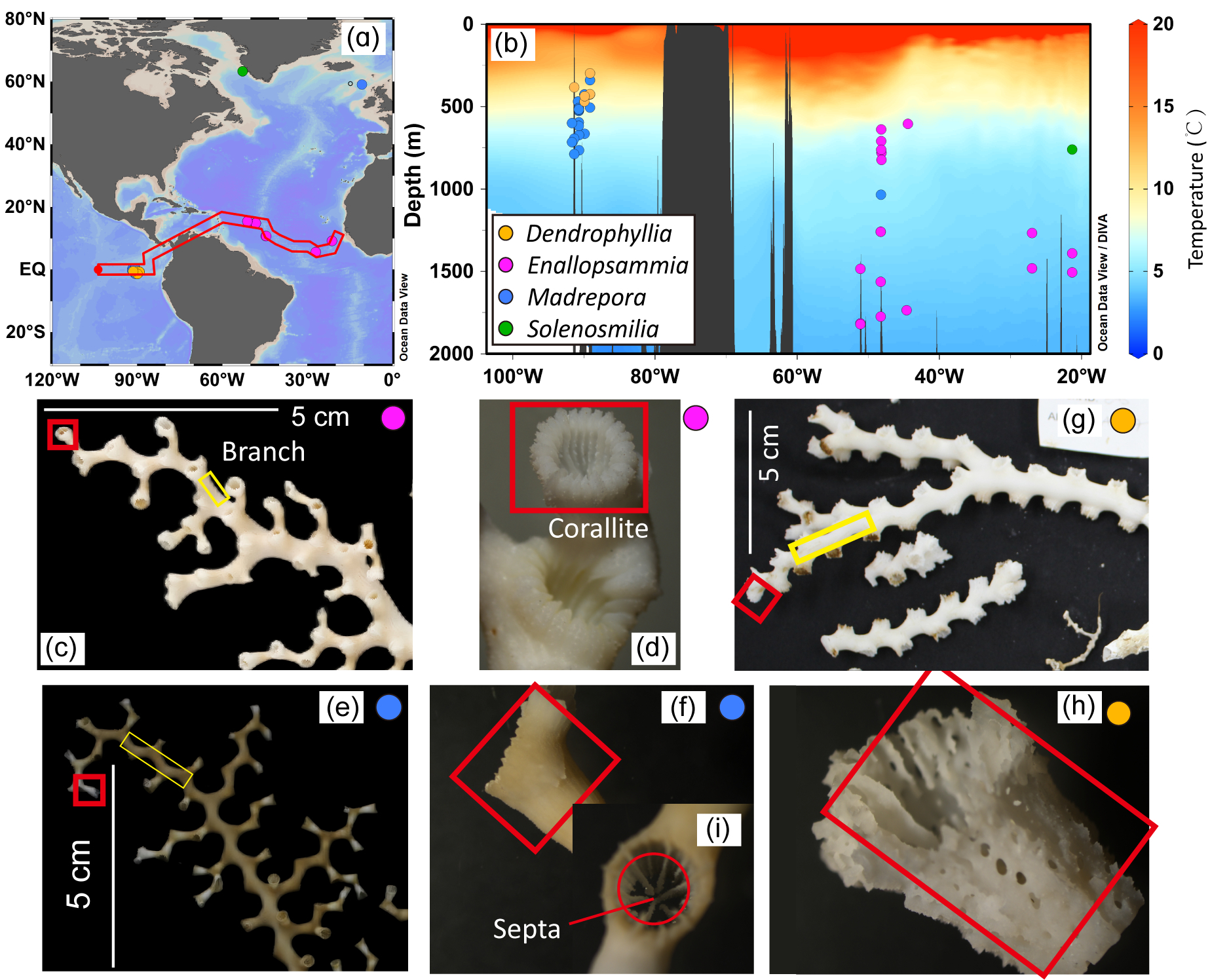
Colonial cold-water coral collection map and the subsampling strategy. (Image by NIGPAS)
<関連情報>
- https://english.cas.cn/newsroom/research_news/earth/202512/t20251210_1135818.shtml
- https://www.sciencedirect.com/science/article/abs/pii/S0012821X25005412
群落性冷水サンゴのLi/Mg古水温測定:成長速度と骨格の不均一性の影響 Colonial cold-water coral Li/Mg palaeothermometry: Influence of growth rate and skeletal heterogeneity
Qian (刘倩) Liu, Joseph A. Stewart, Laura F. Robinson, Sang Chen, Maoyu Wang, Tianyu Chen, Tao Li
Earth and Planetary Science Letters Available online: 1 December 2025
DOI:https://doi.org/10.1016/j.epsl.2025.119743
Highlights
- Li/Mg ratios exhibit a systematic offset between colonial cold-water coral corallites and branches, potentially driven by different growth rates.
- Applying a corallite-based Li/Mg temperature calibration indiscriminately to branch material would lead to a substantial and systematic overestimation of paleotemperature.
- Temperature reconstruction studies using colonial corals must differentiate between corallite and branch skeletal material.
Abstract
Reconstructing past seawater temperatures is essential for understanding ocean circulation and climate linkages, prompting extensive efforts to develop geochemical temperature proxies in marine carbonates that extend records beyond instrumental observations. Trace element ratios in biogenic carbonates offer valuable insights into past ocean temperatures, yet their reliability hinges on a detailed understanding of the chemical heterogeneity within marine calcifiers and the underlying biomineralization mechanisms. This study calibrates Li/Mg, Li/Ca, and Mg/Ca ratios in the corallite (cup skeleton) and branch (i.e., coenosteum) of modern colonial cold-water scleractinian corals (Madrepora, Enallopsammia, Dendrophyllia, Solenosmilia), and uses a numerical biomineralization model to investigate the influence of physiological processes and growth rates on these proxies. We find a systematic offset of Li/Ca, Mg/Ca as well as Li/Mg between corallite and branch, with higher values observed in the corallite. Our results show that while a biocalcification model that assumes constant metal (Me) distribution coefficients (DMe = Me/Cacarbonate / Me/Cafluid) effectively captures the observed Me/Ca correlations, it fails to explain the consistent Li/Mg offset between corallite and branch in these colonial coral specimens. Instead, growth rate difference between corallite and branch might contribute to the consistent Li/Mg offset between the two skeleton structures, with lower growth rates corresponding to the branch. This insight is critical for palaeotemperature reconstructions using colonial corals, as applying a single Li/Mg – temperature calibration to both skeletal components can introduce systematic error. We highlight the need to differentiate between skeletal structures, especially in fossil materials where corallites are often degraded. Our study underscores the need for continued research to reduce the uncertainties associated with Li/Mg paleothermometry.