2025-12-04 ピッツバーグ大学
。<関連情報>
- https://news.engineering.pitt.edu/exciting-chemistry/
- https://www.pittwire.pitt.edu/features-articles/2025/12/04/water-disinfectant-ozone-chlorine-alternative
- https://pubs.acs.org/doi/10.1021/acscatal.5c04461
水酸化過程における酸化スズの電気化学的腐食と触媒ダイナミクス Electrochemical Corrosion and Catalysis Dynamics of Tin Oxide during Water Oxidation
Rayan Alaufey,Lingyan Zhao,Christina Lents,Brianna Markunas,Adam D. Walter,Qin Wu,John A. Keith,and Maureen Tang
ACS Catalysis Published October 27, 2025
DOI:https://doi.org/10.1021/acscatal.5c04461
Abstract
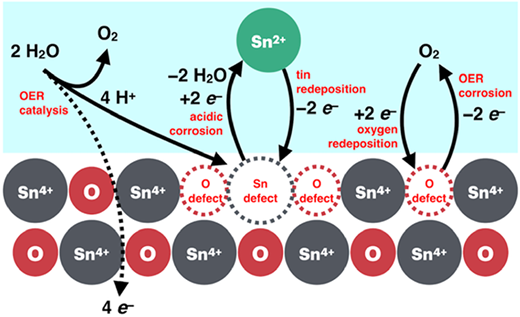
Metal oxide corrosion severely limits anodic electrocatalysis, particularly at high potentials in acidic environments, where degradation pathways remain poorly defined. This study establishes explicit connections between corrosion and electrocatalysis on tin oxide during water oxidation by examining the roles of lattice defects, reactive oxygen species, interfacial pH variations, and speciation of corroded tin in acid. We first demonstrate the presence of structural defects such as oxygen vacancies and substoichiometric Sn(II) species by integrating electron paramagnetic resonance spectroscopy, ultraviolet photoelectron spectroscopy, and Mott–Schottky analysis. Kohn–Sham density functional theory calculations reveal that explicit water structures thermodynamically stabilize reaction intermediates and lower reaction overpotentials. Moreover, we propose that water dissociation leads to hydrogen-bonding networks formed by H* and OH* intermediates, which may span the entire catalyst surface and decrease the interfacial pH to drive corrosion. In contrast, the electrochemical generation of reactive oxygen species is shown to play a minor role in catalyst corrosion during water oxidation using inductively coupled plasma mass spectrometry coupled with selective chemical scavengers. Square-wave voltammetry combined with rotating ring-disk electrodes is used to reveal that under open-circuit conditions, only Sn(IV) cations chemically dissolve from tin oxide, while both Sn(IV) and Sn(II) species electrochemically corrode during water oxidation. Our results unveil a dynamic and complicated interplay between corrosive and catalytic pathways on metal oxide electrocatalysts: a decrease in interfacial pH due to water oxidation exacerbates Sn(II)/Sn(IV) corrosion. Subsequently, the electrochemical corrosion of Sn(II)/Sn(IV) facilitates product formation from lattice oxygen, while the redeposition of corroded Sn(II) as Sn(IV) can enable oxygen exchange with water. By elucidating the roles of defects and interfacial chemistry, this work provides a roadmap for engineering improved electrocatalysts that balance activity and stability, a critical step toward scalable and durable energy technologies.