2025-10-17 中国科学院(CAS)
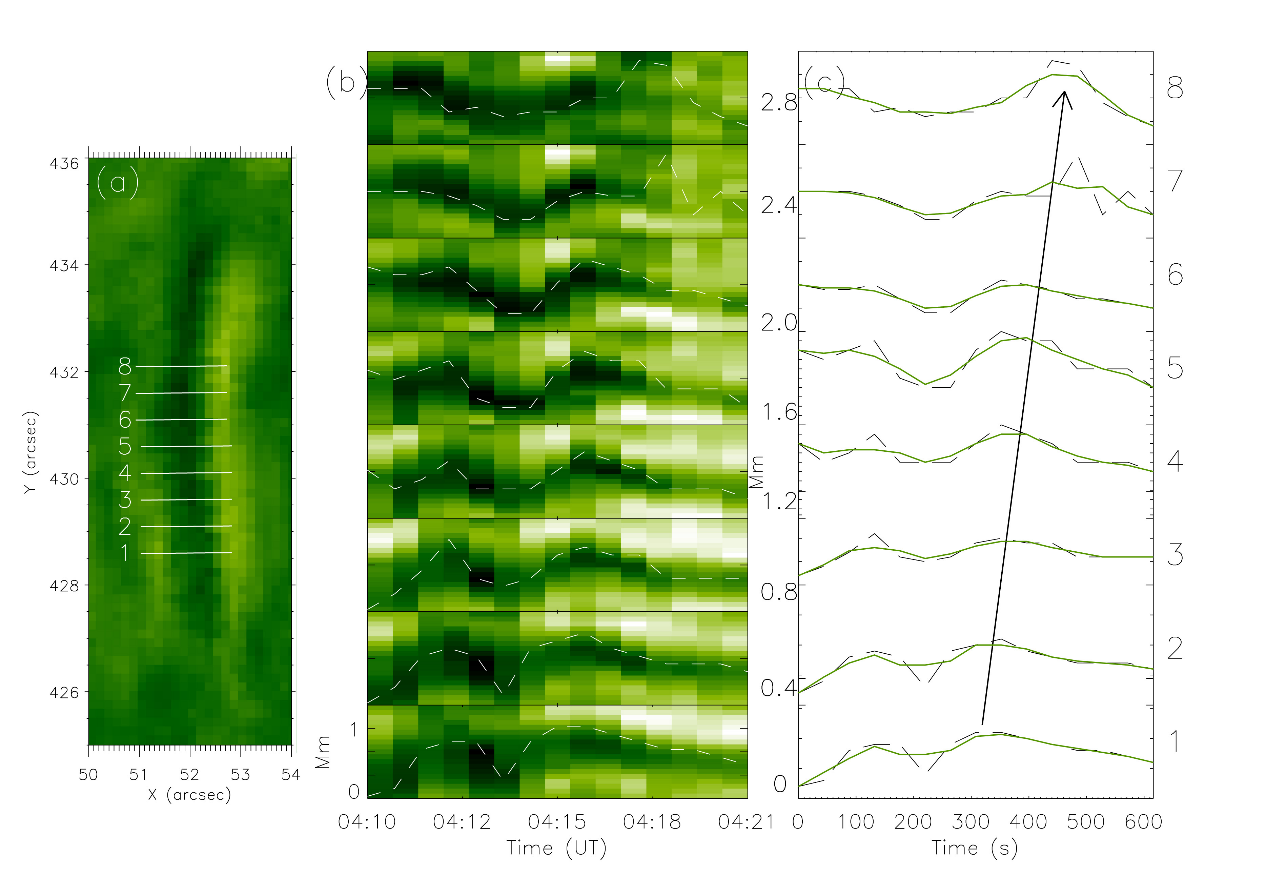
Panel (a): Motion-magnified view of the fibril. The white lines indicate the positions for analyzing transverse oscillations. Panel (b): The space-time plots corresponding to positions 1-8 in panel (a). Panel (c): The lines represent the fitted minimum intensity values for each column. (Image by Prof. YAN Xiaoli)
<関連情報>
- https://english.cas.cn/newsroom/research_news/phys/202510/t20251017_1089630.shtml
- https://academic.oup.com/mnras/article/543/2/1303/8258958?login=false
静止フィラメント周囲の彩層フィブリルの特性 Properties of chromospheric fibrils around a quiescent filament
Qifan Dong, Xiaoli Yan, Zhike Xue, Jincheng Wang, Zhe Xu, Liheng Yang, Yian Zhou, Xinsheng Zhang, Zongyin Wu, Guotang Wu
Monthly Notices of the Royal Astronomical Society Published:19 September 2025
DOI:https://doi.org/10.1093/mnras/staf1567
ABSTRACT
Fibrils are dynamic plasma structures in the solar chromosphere. Studying these structures is critical for understanding solar atmospheric heating and mass transportation. The purpose of this study is to obtain the characteristics of fibrils surrounding the filament. By employing high-resolution Hα data obtained from the New Vacuum Solar Telescope (NVST), we undertake a detailed analysis of the properties of 63 fibrils situated in the vicinity of the filament. Comparing the fibrils on both sides of the filament demonstrates that these fibrils have similar physical properties except for their orientation. The properties of fibrils are statistically measured, including lifetimes of 150–650 s, widths of 320–850 km, maximum lengths of 3–8.5 Mm, projection velocities of 7–29 km s-1, and decelerations of 45–474 m s-2. The dominant oscillation period of fibrils is predominantly concentrated in the range of 4.8–6.6 min (2.5–3.5 mHz). Transverse oscillations are identified in a subset of fibrils, with periodicities of 269–289 s and phase speeds of 13.7–25.8 km s-1, indicating the presence of kink-mode magnetohydrodynamic (MHD) waves.