

2025-09-29 ジョンズ・ホプキンス大学(JHU)
Web要約 の発言:
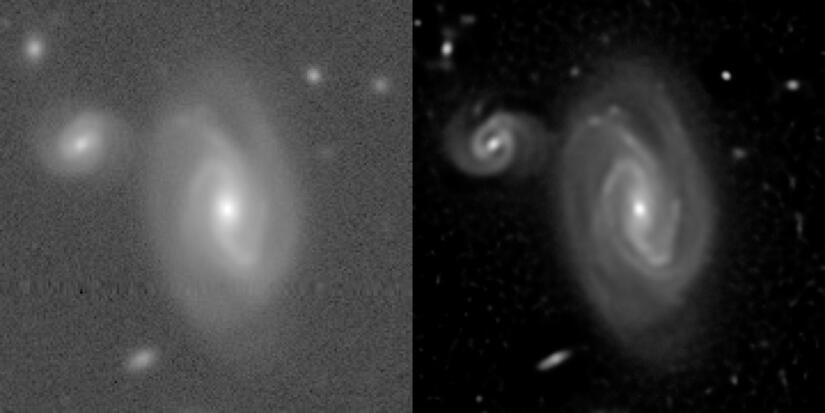
Comparison of an image from the Hyper Suprime-Cam, an ultra-wide-field camera mounted on the Subaru Telescope (left), with an image produced by the new ImageMM algorithm (right). The image on the left is of similar quality to images typically used in practice. Image credit: Johns Hopkins University
<関連情報>
- https://hub.jhu.edu/2025/09/29/hopkins-ground-telescope-images-improved/
- https://iopscience.iop.org/article/10.3847/1538-3881/adfb72
ImageMM: マルチフレーム画像復元と超解像の統合 ImageMM: Joint Multi-frame Image Restoration and Super-resolution
Yashil Sukurdeep, Tamás Budavári, Andrew J. Connolly, and Fausto Navarro
The Astronomical Journal Published: 2025 September 29
DOI:10.3847/1538-3881/adfb72
Abstract
A key processing step in ground-based astronomy involves combining multiple noisy and blurry exposures to produce an image of the night sky with an improved signal-to-noise ratio. Typically, this is achieved via image coaddition, and can be undertaken such that the resulting night sky image has enhanced spatial resolution. Yet, this task remains a formidable challenge despite decades of advancements. In this paper, we introduce ImageMM: a new framework based on the majorization–minimization (MM) algorithm for joint multi-frame astronomical image restoration and super-resolution. ImageMM uses multiple registered astronomical exposures to produce a nonparametric latent image of the night sky, prior to the atmosphere’s impact on the observed exposures. Our framework also features a novel variational approach to compute refined point-spread functions of arbitrary resolution for the restoration and super-resolution procedure. Our algorithms, implemented in TensorFlow, leverage graphics processing unit acceleration to produce latent images in near real time, even when processing high-resolution exposures. We tested ImageMM on Hyper Suprime-Cam (HSC) exposures, which are a precursor of the upcoming imaging data from the Rubin Observatory. The results are encouraging: ImageMM produces sharp latent images, in which spatial features of bright sources are revealed in unprecedented detail (e.g., showing the structure of spiral galaxies), and where faint sources that are usually indistinguishable from the noisy sky background also become discernible, thus pushing the detection limits. Moreover, aperture photometry performed on the HSC pipeline coadd and ImageMM’s latent images yielded consistent source detection and flux measurements, thereby demonstrating ImageMM’s suitability for cutting-edge photometric studies with state-of-the-art astronomical imaging data.

