2025-09-18 中国科学院(CAS)
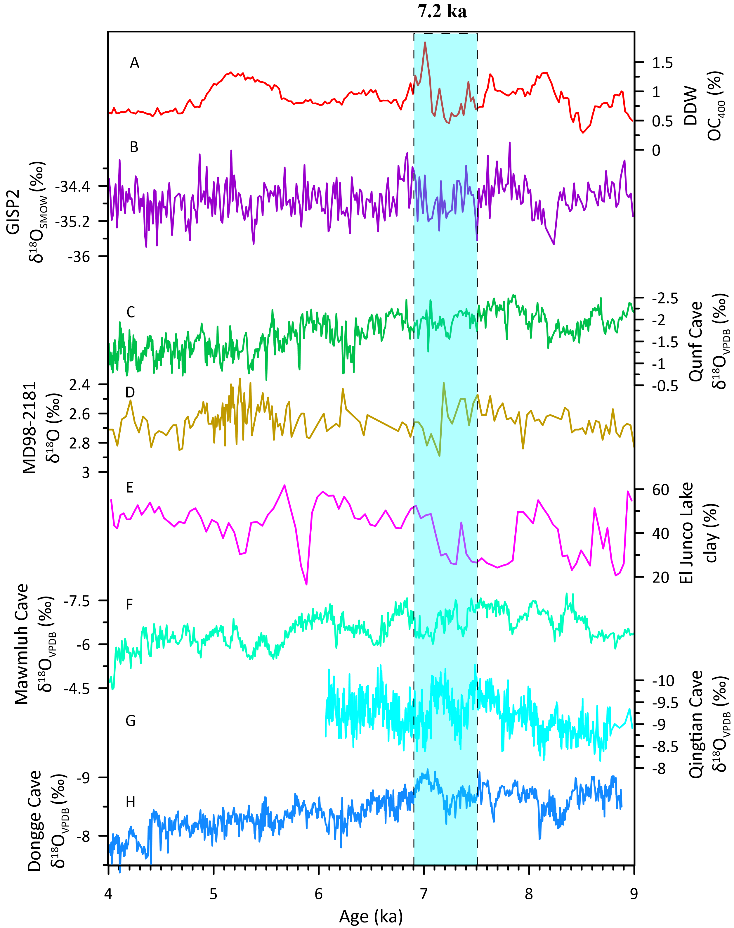
Comparison of the Dadiwan record with other paleoclimate proxies. (Image by LIU Xingxing)
<関連情報>
- https://english.cas.cn/newsroom/research_news/earth/202509/t20250919_1055047.shtml
- https://www.sciencedirect.com/science/article/abs/pii/S0341816225007507
7.2千年前寒冷化事象とその社会的影響:中国黄土高原における大淶文化の気候誘発的停滞期 The 7.2 ka cold event and its societal impact: climate-induced hiatus in the Dadiwan Culture of the Chinese Loess Plateau
Yuqing Yang, Xingxing Liu, Yuan Li, Liangcheng Tan, Xulong Wang, Long Ma, Lele Ren, Peng Cheng, Yuda Chui, Hongli Zhao, Youbin Sun
CATENA Available online: 15 September 2025
DOI:https://doi.org/10.1016/j.catena.2025.109448
Highlights
- We identified the 7.2 ka cold event in the Chinese Loess Plateaus.
- Freshwater fluxes and reduced solar irradiance jointly drove the 7.2 ka event.
- The 7.2 ka cold event may have led to a hiatus in the Dadiwan culture.
Abstract
Abrupt climate events in the Holocene have been recognized as critical factors influencing the evolution of human civilization. The Chinese Loess Plateau (CLP), as one of the cradles of Chinese ancient civilization, witnessed the emergence of numerous early cultures. The Dadiwan Culture (7800–4800cal yr BP), situated in the western CLP, represents one of the earliest centers for dryland agricultural domestication and cultivation systems in northern China. However, this cultural sequence exhibits a pronounced ∼500-year hiatus between its initial (Phase I: 7800–7300cal yr BP) and subsequent (Phase II: 6500–6000cal yr BP) developmental stages, with the causal relationship between this discontinuity and coeval climate variability remaining unresolved. Through high-resolution multiproxy (organic carbon, total nitrogen, grain size) analysis of a high-sedimentation-rate fluvial terrace loess-paleosol sequence in the Dadiwan region, we identified a pronounced weakening of the East Asian summer monsoon (EASM) concurrent with abrupt cooling and aridification at ∼7.2 ka. This climatic anomaly demonstrates temporal correspondence with two key forcing mechanisms: (1) enhanced freshwater fluxes into the North Atlantic Ocean, and (2) reduced solar irradiance during the mid-Holocene. Integrating paleoclimatic reconstructions with archaeological evidence, we infer that this abrupt climate transition likely precipitated the observed cultural discontinuity in the Dadiwan sequence. Our findings elucidate the critical role of centennial-scale climate variability in shaping Neolithic societal trajectories and agricultural adaptation strategies in semi-arid East Asia.