2025-08-19 スイス連邦工科大学ローザンヌ校(EPFL)
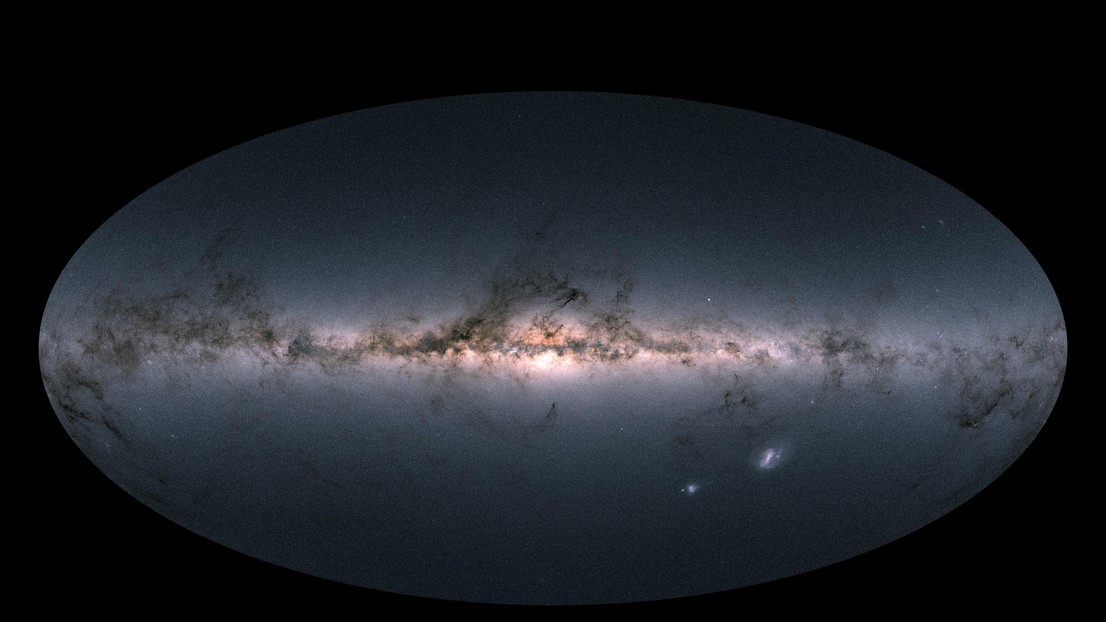
Gaia’s all-sky view of our Milky Way Galaxy and neighbouring galaxies, based on measurements of nearly 1.7 billion stars. Credit: ESA/Gaia/DPAC
<関連情報>
- https://actu.epfl.ch/news/gaia-s-variable-stars-a-new-map-of-the-stellar-lif/
- https://www.aanda.org/articles/aa/full_html/2025/08/aa55111-25/aa55111-25.html
銀河の散開星団における変光星の集団を通じた恒星進化の鳥瞰図 A bird’s eye view of stellar evolution through populations of variable stars in Galactic open clusters
Richard I. Anderson and Emily L. Hunt
Astronomy & Astrophysics Published:13 August 2025
DOI:https://doi.org/10.1051/0004-6361/202555111
Abstract
Both star clusters and variable stars are sensitive laboratories of stellar astrophysics and evolution: cluster member stars provide context for interpreting cluster populations, whereas variability reveals the nature of individual stellar systems. The European Space Agency’s Gaia mission has revolutionized the census of star clusters in the Milky Way, while simultaneously providing an unprecedented homogeneous all-sky catalog of variable stars. Here, we leverage the third Gaia data release to obtain an empirical bird’s eye view of stellar evolution based on 34 760 variable stars residing in 1192 Galactic open clusters (OCs) containing 173 294 members (variable member fraction 20.0%). Using precise OC distances, dereddened magnitudes, and consistently determined ages, we a) pinpointed regions of pulsational instability across the color-absolute magnitude diagram (CaMD); b) traced the occurrence rate of variables as a function of age, and c) considered the evolution of rotation periods and photometric activity (gyrochronology). The occurrence of pulsating stars can serve as a model- and reddening-independent age estimator. Our results underline that jointly considering stellar variability and OC membership enables a plethora of further applications, such as age dating or dereddening OCs based on expected CaMD locations of variable stars. Upcoming Gaia data releases and the Vera C. Rubin Observatory will vastly increase the extent to which the details of variable stars in OCs can empirically unravel the astrophysics and evolution of stellar populations.