2025-08-15 ペンシルベニア州立大学(PennState)
<関連情報>
- https://www.psu.edu/news/materials-research-institute/story/unified-theory-may-reveal-more-superconducting-materials
- https://iopscience.iop.org/article/10.1088/1361-6668/adedbc
密度汎関数理論により対称性破れ超伝導配置を解明する Revealing symmetry-broken superconducting configurations by density functional theory
Zi-Kui Liu and Shun-Li Shang
Superconductor Science and Technology Published: 18 July 2025
DOI:10.1088/1361-6668/adedbc
Abstract
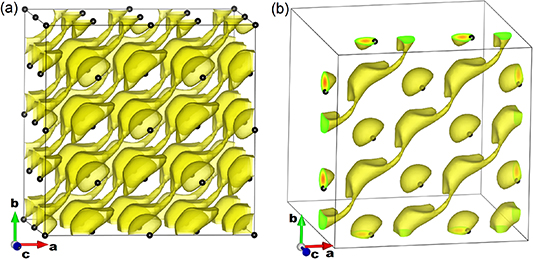
A coherent theory for the superconductivity of both conventional and unconventional superconductors is currently lacking. Here we show that superconductivity arises from the formation of a symmetry-broken superconducting configuration (SCC) due to atomic perturbation of the normal conducting configuration (NCC). This electron–phonon interaction creates straight one-dimensional tunnels (SODTs) for charge density of electrons and/or holes as revealed by the calculations based on density functional theory (DFT). The SODTs act as resistance-free superhighways and are correlated to the Cooper pairs in the Bardeen–Cooper–Schrieffer (BCS) theory. The formation of SODTs implies that the electron–phonon interaction in the BCS theory can be represented by the difference in charge densities between SCC and NCC predicted by DFT. The present work highlights that in conventional superconductors, SODTs are embedded within the bulk materials and are easily destroyed by phonon vibrations, resulting in a low critical superconducting temperature (Tc). Conversely, in unconventional superconductors such as YBa2Cu3O7 (YBCO7), SODTs are protected by a layered pontoon structure with very weak bonding to the bulk materials, maintaining SODTs’ stability at higher temperatures and leading to a much higher Tc. The present approach is validated for 14 conventional superconductors of 18 pure elements and MgB2 examined in this work, including the presently predicted superconductivity in Cu, Ag, Au, Sb, Bi, and MgB2 at 0 K and 0 GPa, and one unconventional superconductor of YBCO7. Our discovery indicates that DFT can be a practical tool for predicting superconductors, enabling a systematic search for new superconducting materials in the future.