2025-07-10 中国科学院(CAS)
<関連情報>
- https://english.cas.cn/head/202507/t20250708_1047061.shtml
- https://www.nature.com/articles/s41586-025-09131-7#citeas
南極エイトケン盆地の玄武岩の超欠乏マントル源 Ultra-depleted mantle source of basalts from the South Pole–Aitken basin
Qin Zhou,Wei Yang,Zhuyin Chu,Honggang Zhu,Saihong Yang,Xingguo Zeng,Ding-Shuai Xue,Li-Hui Jia,Guangliang Zhang,Hongbo Zhang,Yanhao Lin,Huijuan Zhang,Heng-Ci Tian,Peng Peng,Dan-Ping Zhang,Lixin Gu,Chunlai Li & Fu-Yuan Wu
Nature Published:09 July 2025
DOI:https://doi.org/10.1038/s41586-025-09131-7
Abstract
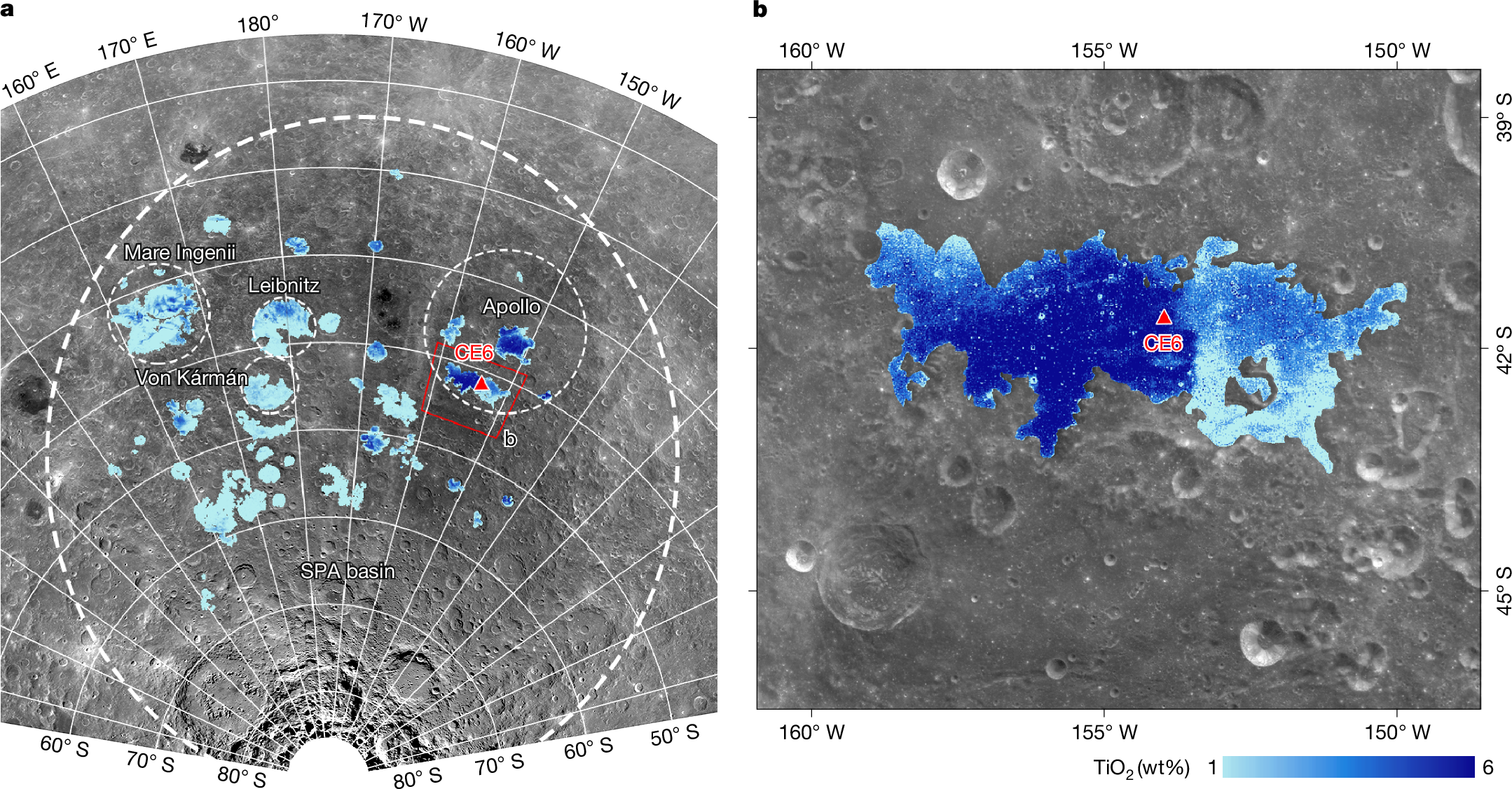
Lunar mare basalts illuminate the nature of the Moon’s mantle, the lunar compositional asymmetry and the early lunar magma ocean (LMO)1,2,3. However, the characteristics of the mantle beneath the vast South Pole–Aitken (SPA) basin on the lunar farside remain a mystery. Here we present the petrology and geochemistry of basalt fragments from Chang’e-6 (CE6), the first returned lunar farside samples from the SPA basin4,5,6,7. These 2.8-billion-year-old CE6 basalts8 share similar major element compositions with the most evolved Apollo 12 ilmenite basalts. They exhibit extreme Sr–Nd depletion, with initial 87Sr/86Sr ratios of 0.699237 to 0.699329 and εNd(t) values (a measure of the neodymium isotopic composition) of 15.80 to 16.13. These characteristics indicate an ultra-depleted mantle, resulting from LMO crystallization and/or later depletion by melt extraction. The former scenario implies that the nearside and farside may possess an isotopically analogous depleted mantle endmember. The latter is probably related to the SPA impact, indicating that post-accretion massive impacts could have potentially triggered large-scale melt extraction of the underlying mantle. Either way, originating during the LMO or later melt extraction, the ultra-depleted mantle beneath the SPA basin offers a deep observational window into early lunar crust–mantle differentiation.