2024-12-10 ワシントン大学セントルイス校
<関連情報>
- https://source.washu.edu/2024/12/scientists-collect-microbial-fingerprints-found-in-household-plumbing/
- https://www.nature.com/articles/s44221-024-00345-z
毎日のサンプリングから、家庭特有の水マイクロバイオームのシグネチャーと、家庭内の配管に共通する抗菌薬レジストームが明らかになった Daily sampling reveals household-specific water microbiome signatures and shared antimicrobial resistomes in premise plumbing
Lin Zhang,Daliang Ning,David Mantilla-Calderon,Yirong Xu,Bingdi Liu,Winston Chen,Jinyu Gao,Kerry A. Hamilton,Jinyong Liu,Jizhong Zhou & Fangqiong Ling
Nature Water Published:10 December 2024
DOI:https://doi.org/10.1038/s44221-024-00345-z
Abstract
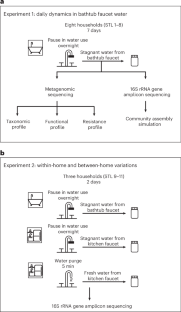
Stagnation in premise plumbing can lead to the degradation of drinking water quality, yet the variability of microbiomes and resistomes in these systems at fine spatiotemporal scales remains poorly understood. Here we track the water microbiome daily across households in St. Louis, Missouri, alongside functional gene profiles and antimicrobial resistomes. Our results show substantial differences in species composition between households, with household identity, instead of temporal fluctuations or specific water-use devices, emerging as the dominant variable shaping microbiome composition. Using LASSO regression models, we identified informative taxa for each household, achieving an average accuracy of 97.5% in estimating a sample’s household origin. Notably, distinct profiles of opportunistic premise plumbing pathogens (OPPPs) were detected, with Mycobacterium gordonae being twice as prevalent as M. chelonae. Community assembly simulations indicated that stochastic processes primarily drive household-level taxonomic variation. In contrast, antimicrobial resistomes and functional gene repertoires were similar across households, likely influenced by common chloramine residuals applied throughout the local water distribution systems. Genes conferring resistance to beta-lactams were prevalent in bathtub faucet water across all households. These results highlight the need to incorporate household-level species variation when assessing health risks from OPPPs and monitoring antimicrobial resistance. These findings also pave the way for new research to better understand plumbing environments as potential routes for the transmission of resistant bacteria and their genes.