2026-04-03 オックスフォード大学
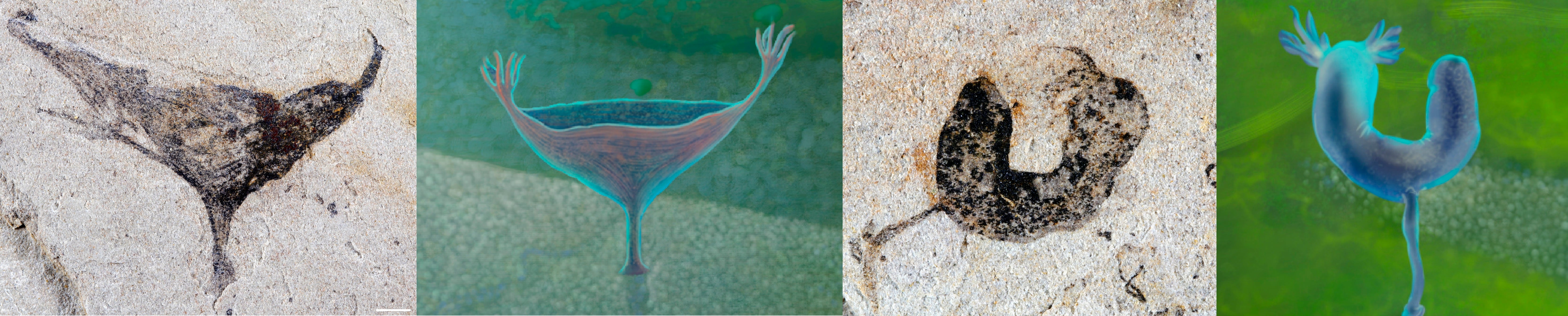
Left: Haootia-like fossil (an early cnidarian – the phylum that includes jellyfish, sea anemones and corals) from the Jiangchuan Biota (scale bar: 2 mm) and artist’s reconstruction. Right: A deuterostome cambroernid fossil from the Jiangchuan Biota (scale bar: 2mm) and artist’s reconstruction. Credits: Gaorong Li (fossil photographs) and Xiaodong Wang (artistic reconstruction).
<関連情報>
- https://www.ox.ac.uk/news/2026-04-03-spectacular-fossil-treasure-trove-pushes-back-origins-complex-animals
- https://www.science.org/doi/10.1126/science.adu2291
顕生代の幕開け:中国南西部のエディアカラ紀後期に生息した過渡期の動物相 The dawn of the Phanerozoic: A transitional fauna from the late Ediacaran of Southwest China
Gaorong Li, Fan Wei, Wenwen Wen, Xiaodong Wang, […] , and Peiyun Cong
Science Published:2 Apr 2026
DOI:https://doi.org/10.1126/science.adu2291
Editor’s summary
The Cambrian period is well known for its explosion of forms, notably many that represent the ancestral versions of modern phyla. The period before the Cambrian, the Ediacaran, also saw an explosion of forms, in this case the emergence of larger bodied, multicellular life. Little has been known about the transition between these two periods. Li et al now describe a site in southwestern China that includes many organisms from both biotas, including classic Ediacaran macrobionts alongside early bilaterians and deuterostome animals. This site thus fills a critical gap in our understanding about the transition between these two enigmatic faunas. —Sacha Vignieri
Abstract
Animal diversification across the Ediacaran-Cambrian transition was a crucial event in Earth history, fundamentally altering our planet and its biosphere. However, Ediacaran fossil assemblages show limited overlap with those from the Cambrian, obscuring the critical interval when the animal phyla were diversifying. We report a new terminal Ediacaran fossil assemblage preserved as carbonaceous films from the Jiangchuan Biota, Yunnan, Southwest China. This assemblage diverges from coeval sites, preserving Ediacaran body fossils alongside recognizable nonbilaterians and bilaterian body and trace fossils. These include diverse vermiform animals and the oldest deuterostomes (stem-group ambulacrarians). Our discovery provides insight into the radiation of Bilateria, the most diverse and disparate animal clade.