2026-04-01 中国科学院(CAS)
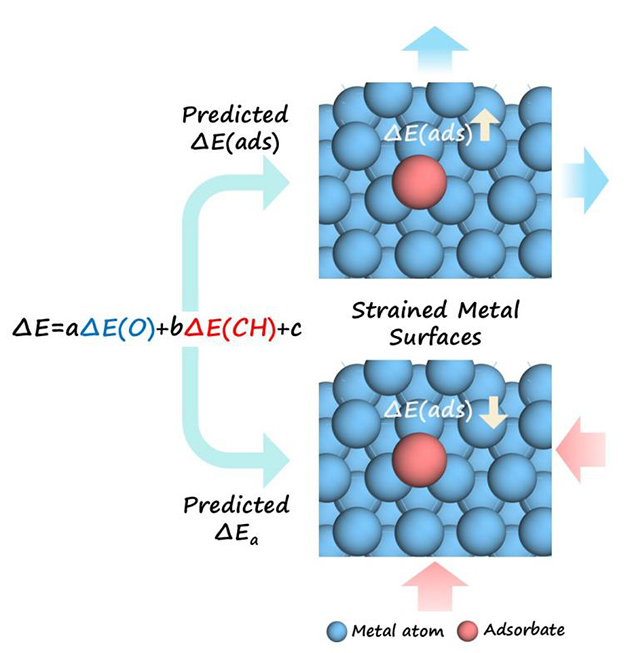
Schematics for the dual-descriptor scaling relation. (Image by LICP)
<関連情報>
- https://english.cas.cn/newsroom/research-news/202603/t20260331_1154316.shtml
- https://www.cell.com/cell-reports-physical-science/fulltext/S2666-3864(26)00125-6
金属表面における吸着および反応に対する歪みの影響の一般的な傾向 General trend of strain effect on the adsorption and reactions over metal surfaces
Tingting Wang ∙ Zhiwei Huang ∙ Bin Hu ∙ Yongjie Xi
Cell Reports Physical Science Published:March 31, 2026
DOI:https://doi.org/10.1016/j.xcrp.2026.103219
Highlights
- Different characteristics of the energetics that change in response to surface strain
- A dual-descriptor scaling relation is established to describe strain effect
- Machine learning reveals the origin of the different characteristics of strain effect
Summary
Strain effect can effectively regulate catalytic performance, as tensile (compressive) strain shifts the d-band center of metal surfaces, strengthening (weakening) adsorption energies. While this rationale can explain strain effects qualitatively, a general quantitative description across different metals is lacking. Here, we report that a dual-descriptor scaling relation can describe the response of adsorption energy and activation energy to lattice strain on close-packed metal surfaces. By classifying adsorbates according to their electronegativity, we show that a general adsorbate exhibits the combined features of strong- and weak-electronegativity adsorbates. The dual-descriptor model can account for these features and reliably predict both stationary- and transition-state energetics. We further clarify the physical origin of the distinct responses of different adsorbates using machine learning classification. This study advances the understanding of strain effects in heterogeneous catalysis and provides a quantitative framework for rational catalyst design.