
2026-03-17 大阪公立大学
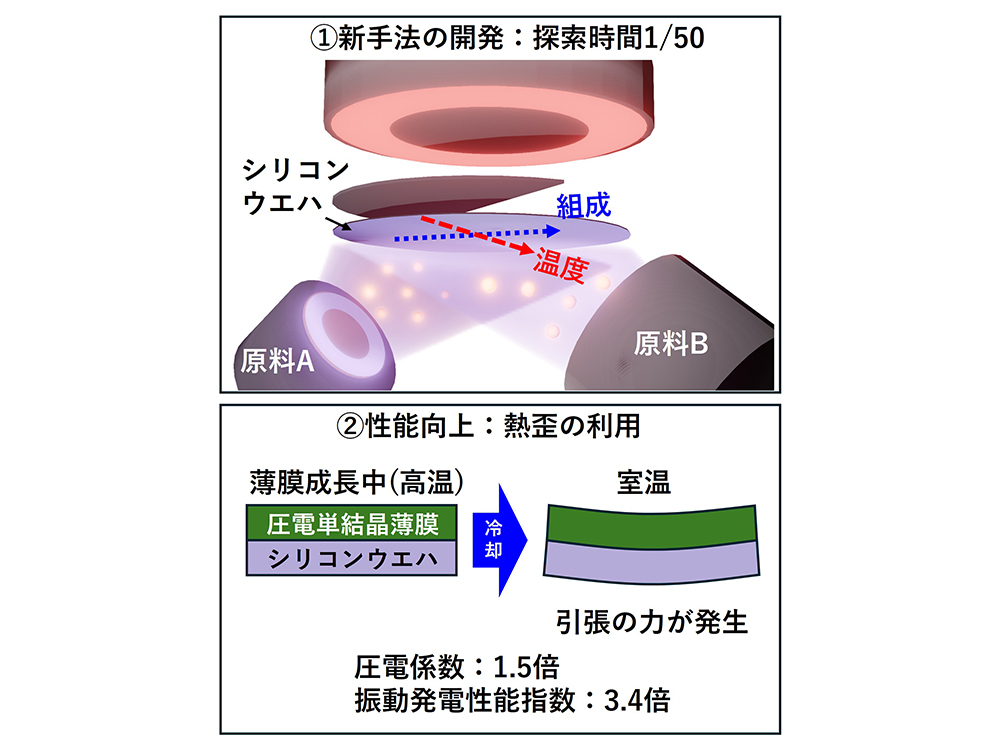
図1 研究の概要:効率的な材料探索と半導体基板上での性能向上
<関連情報>
- https://www.omu.ac.jp/info/research_news/entry-22870.html
- https://www.nature.com/articles/s41378-026-01177-5
マンガン添加ビスマスフェライトエピタキシャル膜における歪み誘起相転移による圧電MEMS振動エネルギーハーベスターの電気機械結合の強化 Enhanced electromechanical coupling in piezoelectric MEMS vibration energy harvesters via strain-induced phase transition in Mn-doped bismuth ferrite epitaxial films
Sengsavang Aphayvong,Meika Takagi,Kira Fujihara,Yohane Fujibayashi,Norifumi Fujimura,Hidemasa Yamane,Shuichi Murakami & Takeshi Yoshimura
Microsystems & Nanoengineering Published:17 March 2026
DOI:https://doi.org/10.1038/s41378-026-01177-5
Abstract
Mn-doped BiFeO3 (BFMO) epitaxial films grown on (100) Si wafers delivered enhanced electrical and piezoelectric properties under systematically optimized growth conditions, realized through a biaxial combinatorial sputtering method. The dielectric constant and dielectric loss of the resulting BFMO films were approximately 140 and 1%, respectively, considerably lower than those of undoped BiFeO3. Most notably, the effective transverse piezoelectric coefficient was –6.0 C/m2, the highest yet reported for this material system. According to detailed structural and electrical characterizations, the improved piezoelectric performance stems from a strain-induced phase transition from the rhombohedral to the monoclinic structure. To demonstrate this enhancement beyond the material level, the optimized films were successfully integrated into piezoelectric MEMS vibration-energy harvesters. The films demonstrated device-level performance improvements with a generalized electromechanical coupling factor of 0.5%, fivefold that of (100) oriented BFO films.

