
2023-03-16 カリフォルニア大学サンディエゴ校(UCSD)
<関連情報>
- https://today.ucsd.edu/story/human-made-chemicals-found-throughout-ocean-environments
- https://www.nature.com/articles/s41561-026-01928-z
海洋溶存有機物中に人為起源化合物が広く存在している Widespread presence of anthropogenic compounds in marine dissolved organic matter
Jarmo-Charles J. Kalinski,Abzer K. Pakkir Mohamed Shah,Bruno Ruiz Brandão da Costa,Shane P. Farrell,Lisa Schellenberg,Lana G. Graves,Tilman Schramm,Paolo Stincone,Irina Koester,Brandon M. Stephens,Ralph R. Torres,Lucia Cancelada,Caroline Utermann-Thüsing,Zachary A. Quinlan,Linda Wegley Kelly,Craig A. Carlson,Cristóbal Castillo-Ilabaca,Silvio Pantoja-Gutiérrez,J. Michael Beman,Aaron Hartmann,Allegra Aron,Xavier Siwe Noundou,Rosemary A. Dorrington,Deniz Tasdemir,…
Daniel Petras
Nature Geoscience Published:16 March 2026
DOI:https://doi.org/10.1038/s41561-026-01928-z
Abstract
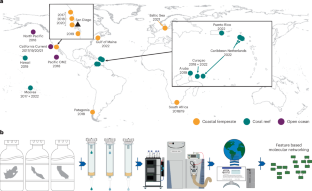
Chemical pollution has profound impacts on marine ecosystem health and services. Most investigations of the distributions of anthropogenic organic chemicals (xenobiotics) have been regionally focused, which limits our understanding of the extent of chemical pollution in the world’s largest biome. To address this gap, we mapped the presence of xenobiotics across marine ecosystems. Here we present a meta-analysis of 21 public non-targeted tandem mass spectrometry datasets, which are not restricted to a predefined set of compounds but rather capture thousands of chemicals. These datasets comprise 2,315 seawater samples, spanning coastal to open ocean environments across three ocean basins. Our analysis revealed that common pollutants such as pesticides and pharmaceuticals were predominantly detected in estuaries and coastal areas but declined with distance from shore, whereas industrial chemicals and additives, including polyalkylene glycols, phthalates and organophosphates, were widely distributed across marine ecosystems. A total of 248 annotated xenobiotic features contributed a median of 2% to the total detected peak area per sample. We observed highest median levels of xenobiotic contribution in coastal datasets (up to 20%) and lowest levels (0.5%) in open ocean datasets, which indicates that anthropogenic organic substances contribute substantially to the dissolved organic matter pool in the surface ocean.


