
2026-03-11 オックスフォード大学
<関連情報>
- https://www.ox.ac.uk/news/2026-03-11-new-study-suggests-ultrasound-could-help-save-hedgehogs
- https://royalsocietypublishing.org/rsbl/article/22/3/20250535/480731/Hearing-and-anatomy-of-the-ear-of-the-European
ヨーロッパハリネズミ(Erinaceus europaeus)の聴覚と耳の解剖学 Hearing and anatomy of the ear of the European hedgehog Erinaceus europaeus
Sophie Lund Rasmussen, David W Macdonald, Rikke Nora Rosenkvist Hansen, Heidi Maria Thomsen, Henrik Lauridsen, Aage Kristian Olsen Alstrup, Jakob Christensen-Dalsgaard
Biology Letters Published: 11 Mar 2026
DOI:https://doi.org/10.1098/rsbl.2025.0535
Abstract
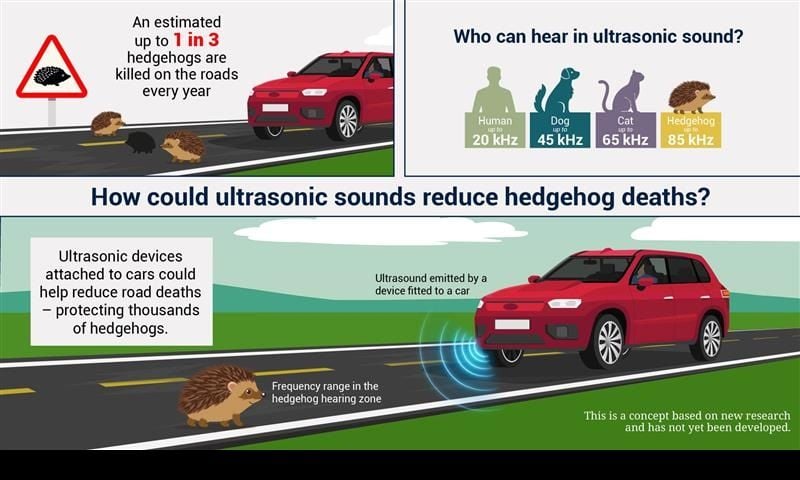
A major threat to the declining European hedgehog (Erinaceus europaeus) is road traffic. Devising methods to reduce the number of collisions would increase hedgehog welfare in an urbanized world and serve to protect this flagship species, and this goal might be advanced by an understanding of their hearing. This study investigates the auditory capabilities and anatomy of the ear of the European hedgehog. Using auditory brainstem response testing on 20 live hedgehogs from Danish wildlife rescue centres, we measured hearing thresholds across 4–85 kHz and found a peak sensitivity around 40 kHz, revealing that European hedgehogs can hear sound frequencies of at least 4–85 kHz. Complementary postmortem micro-CT scans enabled a detailed three-dimensional reconstruction of the inner ear, revealing small middle ear bones with a cochlear spiral of approximately 1.7 turns. Results show that hedgehogs can perceive a broad ultrasonic range, which provides important cues for directional hearing and may additionally function in prey detection and communication. These findings provide critical insights into hedgehog sensory biology and inform the potential development of ultrasonic repellents to mitigate traffic collisions and habitat disturbances, contributing to conservation strategies for this declining species.

