2026-03-04 米国国立再生可能エネルギー研究所(NREL)
<関連情報>
- https://www.nlr.gov/news/detail/program/2026/researchers-use-light-to-tune-electronic-properties-in-ultrathin-materials
- https://advanced.onlinelibrary.wiley.com/doi/10.1002/adma.202409825
ウエハスケールMoS 2膜における空間的に正確な光活性化脱ドーピング Spatially Precise Light-Activated Dedoping in Wafer-Scale MoS2 Films
Debjit Ghoshal, Goutam Paul, Srikrishna Sagar, Cole Shank, Lauren A. Hurley, Nina Hooper, Jeiwan Tan, Kory Burns, Jordan A. Hachtel, Andrew J. Ferguson, Jeffrey L. Blackburn …
Advanced Materials Published: 23 October 2024
DOI:https://doi.org/10.1002/adma.202409825
Abstract
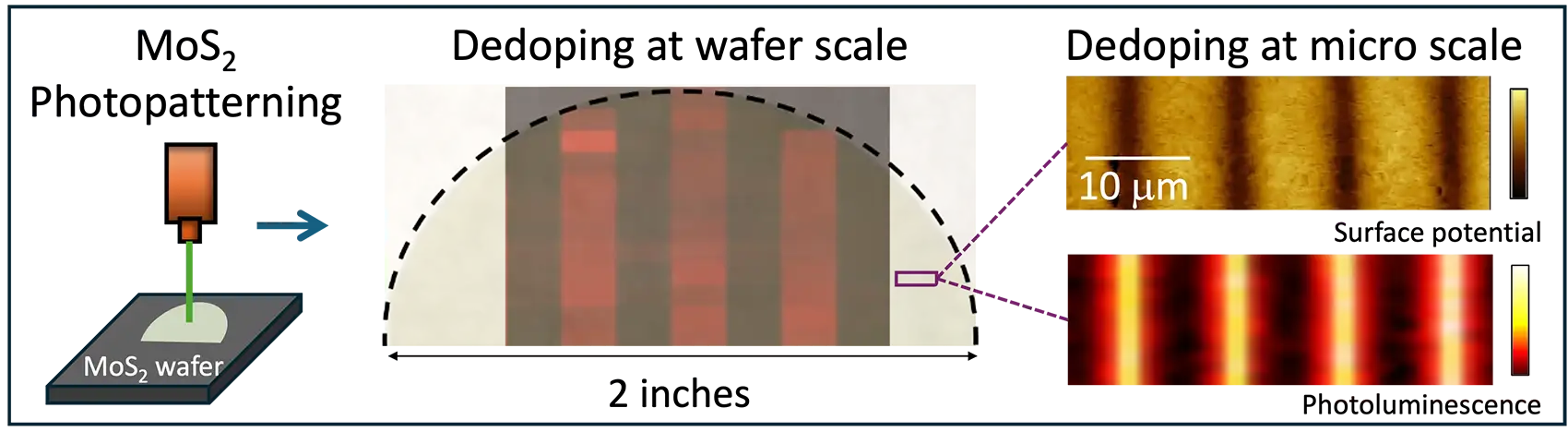
2D materials, particularly transition metal dichalcogenides (TMDCs), have shown great potential for microelectronics and optoelectronics. However, a major challenge in commercializing these materials is the inability to control their doping at a wafer scale with high spatial fidelity. Interface chemistry is used with the underlying substrate oxide and concomitant exposure to visible light in ambient conditions for photo-dedoping wafer scale MoS2. It is hypothesized that the oxide layer traps photoexcited holes, leaving behind long-lived electrons that become available for surface reactions with ambient air at sulfur vacancies (defect sites) resulting in dedoping. Additionally, high fidelity spatial control is showcased over the dedoping process, by laser writing, and fine control achieved over the degree of doping by modulating the illumination time and power density. This localized change in MoS2 doping density is very stable (at least 7 days) and robust to processing conditions like high temperature and vacuum. The scalability and ease of implementation of this approach can address one of the major issues preventing the “Lab to Fab” transition of 2D materials and facilitate its seamless integration for commercial applications in multi-logic devices, inverters, and other optoelectronic devices.