2026-03-02 ワシントン大学セントルイス校
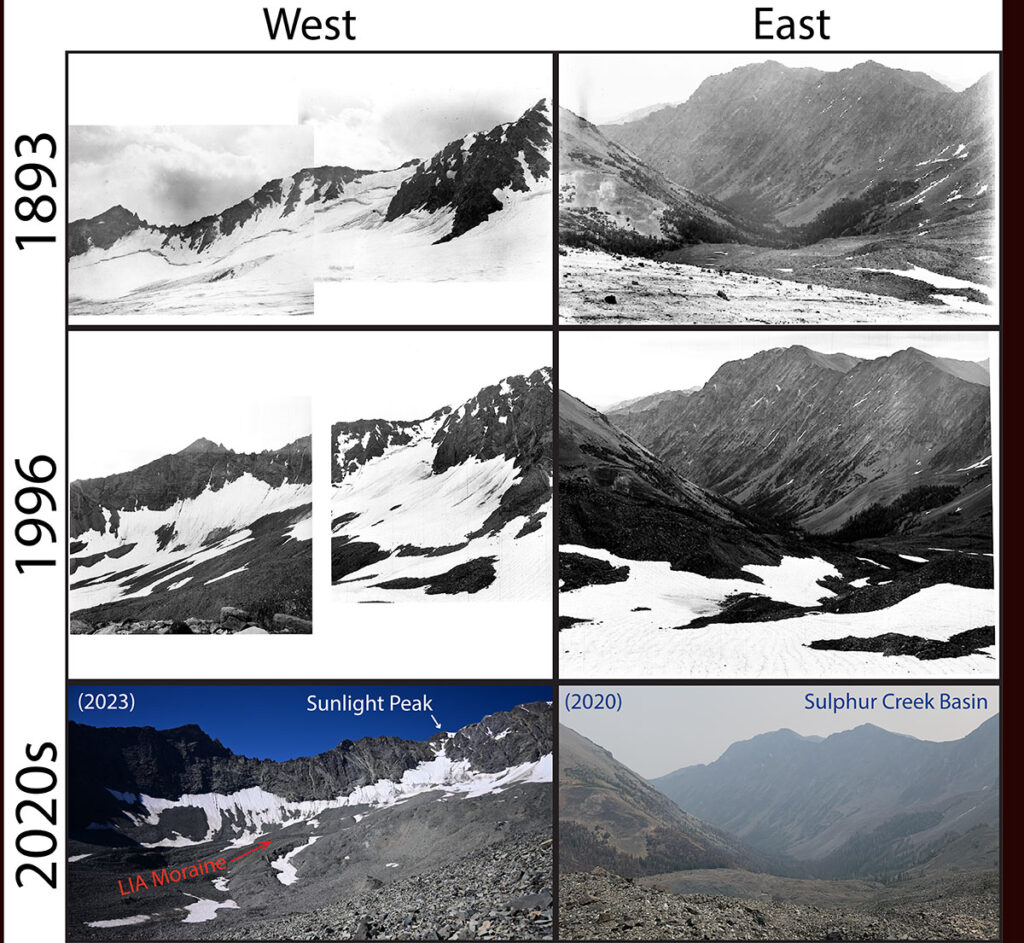
Late summer photographs of Sunlight Peak (west) and the Sulphur Creek basin (east) capture glacier views from similar perspectives during the late 19th century and the early 21st century. (Image: Tyler Meng)
<関連情報>
- https://source.washu.edu/2026/03/sun-sets-on-the-sunlight-glacier/
- https://www.cambridge.org/core/journals/annals-of-glaciology/article/sun-is-setting-for-the-historic-sunlight-glacier-absaroka-mountains-wyoming-usa/B65C0D1FAD4B0C54826824FEE5418F8A
アメリカ、ワイオミング州アブサロカ山脈の歴史的なサンライト氷河に太陽が沈む The Sun is setting for the historic Sunlight Glacier, Absaroka Mountains, Wyoming, USA
Tyler M. Meng,Noel Potter Jr.,Roberto J. Aguilar,Eric I. Petersen,Stefano Nerozzi,Michael F. Daniel,John W. Holt,Nathaniel E. Putzig,Aaron T. Russell andRoger J. Michaelides,…
Annals of Glaciology Published:02 February 2026
DOI:https://doi.org/10.1017/aog.2026.10041
Abstract
An alpine glacier below Sunlight Peak in northwest Wyoming was first photographically documented in 1893, near the end of the Little Ice Age and during the time of industrialization. Since then, evolving technologies have been applied to observe this glacier and nearby discontinuous permafrost for studies spanning Earth, environmental, and planetary sciences. Surveys in the 21st century indicate negative mass balance coinciding with rising average air temperature. This paper reviews the geological and geophysical data on record for the Sunlight Glacier system, presents new results from a 2023 fieldwork campaign combined with remote sensing analysis and comments on likely scenarios of future evolution for this individual body of ice within a broader alpine cryosphere feeding the watersheds of western North America.