
2026-03-02 イリノイ大学アーバナ・シャンペーン校
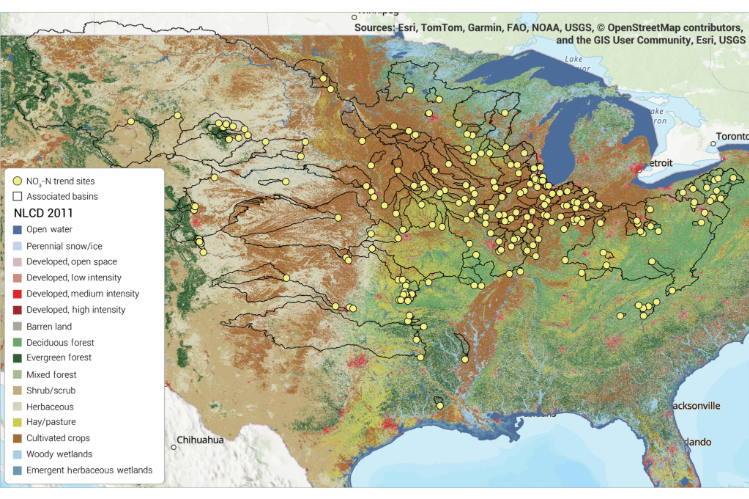
A map of the watershed areas sampled in the study.
<関連情報>
- https://aces.illinois.edu/news/study-shows-20-year-decline-nitrate-pollution-across-portions-mississippi-river-basin
- https://spj.science.org/doi/10.34133/olar.0131
ミシシッピ川流域における陸上窒素収支と河川硝酸態窒素収量の2000年から2020年までの変動 Changes in Terrestrial N Budgets and Riverine Nitrate-N Yields from Mississippi River Basin Watersheds 2000 to 2020
Gregory F. McIsaac, Dennis P. Swaney, Alejandra Botero-Acosta, and Robert W. Howarth
Ocean-Land-Atmosphere Research Published:16 Feb 2026
DOI:https://doi.org/10.34133/olar.0131
Abstract
The Mississippi–Atchafalaya River Basin (MARB) drains approximately 40% of the continental United States and discharges into the Northern Gulf of Mexico, where a large area of benthic hypoxia forms in late summer, largely in response to N loads from the MARB. Trend analysis revealed changes in nitrate-N (NO3-N) loads in MARB subbasins from 2000 to 2020, although causes are uncertain. Net anthropogenic N inputs (NANI), the net of estimated N inputs and outputs from human activities, has been correlated with riverine N loads in many regions worldwide. Here, we incorporate reported changes in crop N content and biological N fixation into NANI estimates and investigate correlations with flow-normalized (FN) riverine N yields from 217 watersheds in the MARB. Reductions in crop N content in corn and soybean influenced values of NANI but had little influence on NANI correlations with riverine FN NO3-N, which generally ranged from 0.5 to 0.7. In the late 1990s and early 2000s, NANI values and FN NO3-N yields were generally high for watersheds with a high percentage of cultivated cropland and tile drainage; by 2020, both NANI and FN NO3-N yields from these watersheds had declined. The magnitude of the decline in FN NO3-N yields from watersheds with greater than 20% tile drainage averaged 552 kg N km−2 year−1. In these watersheds, the largest reductions in NANI were due to greater N harvest in maize and wheat with little change in N fertilizer, and a reduction in atmospheric N deposition.



