2026-03-03 中国科学院(CAS)
<関連情報>
- https://english.cas.cn/newsroom/research-news/202602/t20260228_1151325.shtml
- https://www.nature.com/articles/s41561-026-01942-1
住宅暖房用の低煙燃料は超微粒子排出量の増加と関連している Low-smoke fuels for residential heating linked to an increase in ultrafine particle emissions
Chunshui Lin,Darius Ceburnis,Anna Trubetskaya,Lu Lei,Shan Wang,Yi Liu,Wei Yuan,Haitao Cui,William Smith,Robert Johnson,Kirsten N. Fossum,Vasily Lebedev,Vincent Carré,Rory F. D. Monaghan,Douglas Worsnop,Lidia Morawska,Tao Wang,Ru-Jin Huang,Colin O’Dowd & Jurgita Ovadnevaite
Nature Geoscience Published:02 March 2026
DOI:https://doi.org/10.1038/s41561-026-01942-1
Abstract
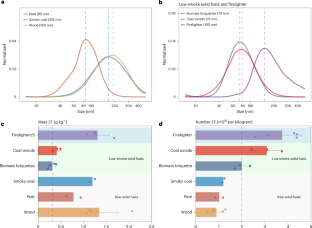
Despite national variations, current air quality standards worldwide focus on reducing mass concentrations of atmospheric particulate matter to lower public health risks. However, these standards fall short in addressing the adverse health effects associated with ultrafine particles, which can penetrate deeper into the human lungs and even pass the blood–brain barrier. Here we present experimental, model and field data in addition to a lung deposition analysis to show there is a rise in ultrafine particle resulting from the transition to ‘low-smoke’ fuels in the residential sector. These low-smoke fuels, designed to lower particulate mass emissions, have unexpectedly led to a two-to-threefold increase in the emissions of ultrafine particle numbers, resulting in a higher contribution to lung deposition particles than all their smoky counterparts combined. Current air quality models underestimate ultrafine particles by a factor of ten, suggesting an underestimation of the health impacts when only particle mass was considered. These ultrafine particle events contrast sharply with the haze events that typically involve larger accumulation mode particles. Our findings highlight the urgent need to revise air quality standards to include ultrafine particles, ensuring air quality management strategies reduce mass concentration without the cost of increasing ultrafine particle number.