2026-02-26 北海道大学
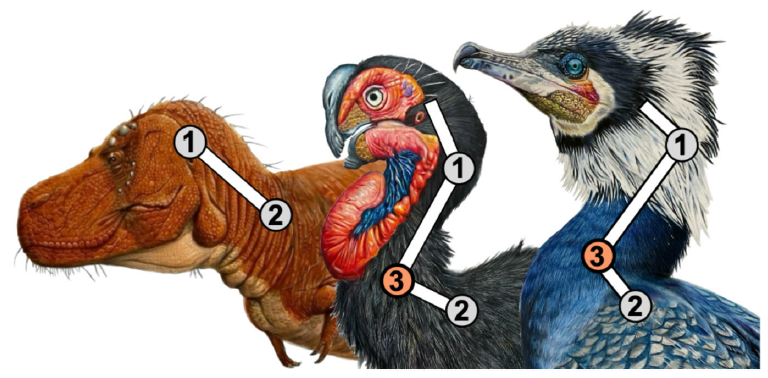
恐竜から鳥へ、首の柔軟性の進化。典型的な恐竜(左:可動部2か所)から、恐竜のマニラプトル類(中央:3か所)、現生鳥類(右:3か所)へ
<関連情報>
- https://www.hokudai.ac.jp/news/2026/02/post-2195.html
- https://www.hokudai.ac.jp/news/pdf/260226_pr.pdf
- https://onlinelibrary.wiley.com/doi/10.1002/jmor.70114
主竜類の機能形態が示す、鳥類の柔軟な頚部動作への進化的知見 Functional Morphology of the Archosaur Neck Provides Evolutionary Insights Into the Avian Neck Flexibility
Yohei Utsuki, Yoshitsugu Kobayashi
Journal of Morphology Published: 27 January 2026
DOI:https://doi.org/10.1002/jmor.70114
ABSTRACT
The amniote neck has evolved extensive mobility and this has contributed to functional and ecological diversification across the clade. Among amniotes, extant birds exhibit an S-shaped neck with multiple flexion points and displays significant variation in vertebral counts and morphology, enabling diverse foraging and feeding behaviors. While avian neck flexibility has increasingly attracted attention in ethology and functional morphology in recent years, its evolution within the archosaur lineage leading to birds remains unclear. Here, we quantified the ratio of the lever lengths (RLL) of selected muscles in the presacral vertebrae of extant crocodilians and birds as an index of joint rotation efficiency. Both crocodilians and birds display high RLL values at vertebral joints near the skull and the cervico-thoracic transition, suggesting that the functional cervical region lies anterior to the latter joint in both clades. In crocodilians, the position of this posterior high RLL joint varies among major lineages, implying that differences in cervical vertebral counts may be linked to lineage specific feeding ecologies. In contrast, birds possess an additional cervical region with high RLL values between the two major high RLL joints. This mid-posterior cervical subregion appears to be an avian evolutionary novelty that enhances rotational efficiency and likely facilitated the evolution of the highly flexible, multi-point bending neck unique to birds.