2026-02-16 アリゾナ大学
<関連情報>
- https://news.arizona.edu/news/cosmic-predators-how-supermassive-black-holes-slow-star-growth-nearby-galaxies
- https://iopscience.iop.org/article/10.3847/2041-8213/ae1f8e
クエーサーの放射フィードバックは、 z = 6.3における銀河間スケールでの銀河の成長を抑制する可能性がある Quasar Radiative Feedback May Suppress Galaxy Growth on Intergalactic Scales at z = 6.3
Yongda Zhu, Eiichi Egami, Xiaohui Fan, Fengwu Sun, George D. Becker, Christopher Cain, Huanqing Chen, Anna-Christina Eilers, Yoshinobu Fudamoto, Jakob M. Helton
The Astronomical Journal Letters Published: 2025 December 3
DOI:10.3847/2041-8213/ae1f8e
Abstract
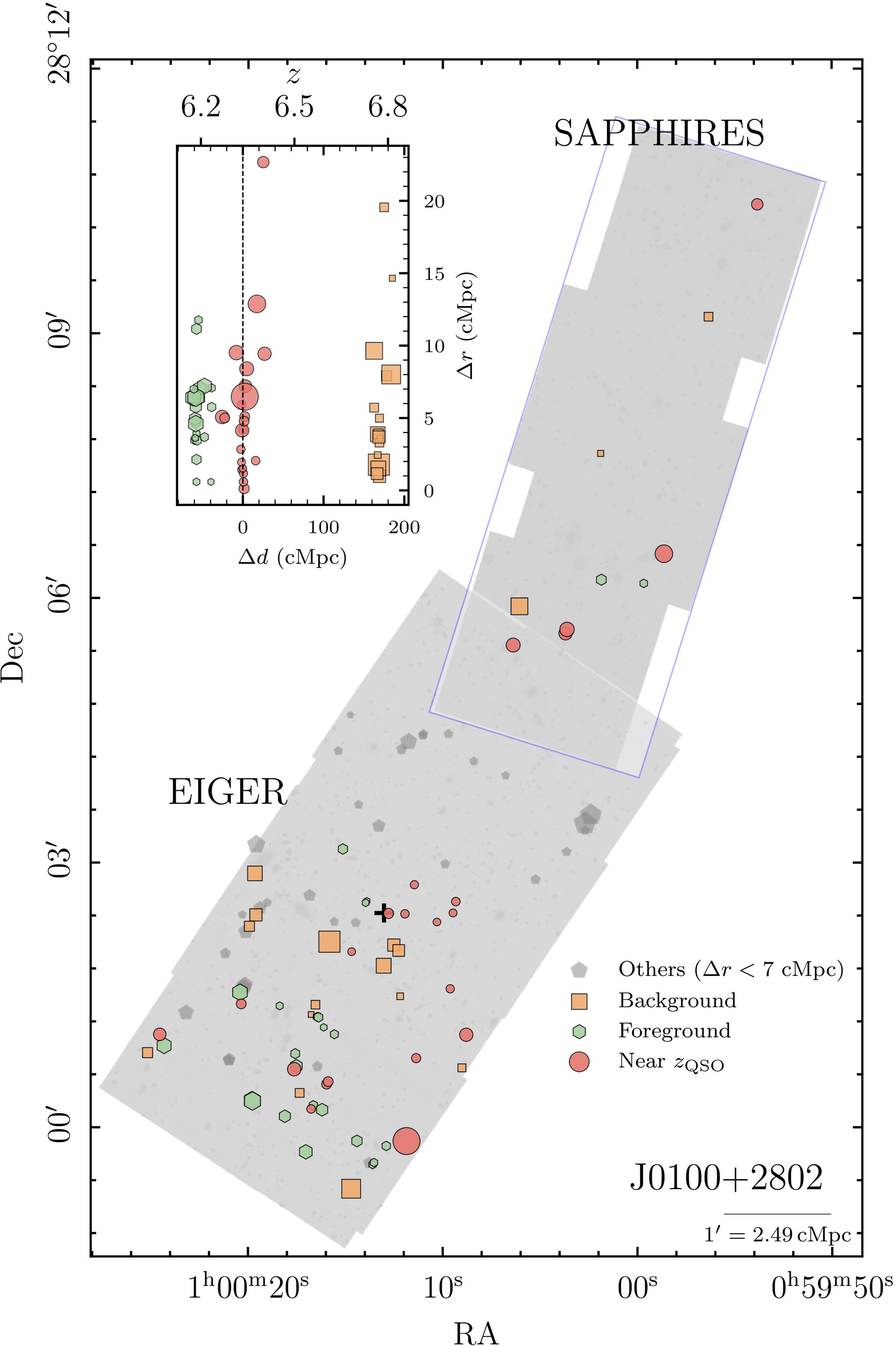
We present observational evidence that intense ionizing radiation from a luminous quasar suppresses nebular emission in nearby galaxies on intergalactic scales at z = 6.3. Using JWST/NIRCam grism spectroscopy from the Slitless Areal Pure-Parallel High-Redshift Emission survey and Emission-line galaxies and Intergalactic Gas in the Epoch of Reionization programs, we identify a moderate but statistically significant decline in [O iii] λ5008 luminosity relative to the UV continuum (L5008/L1500) among galaxies within ∼7 comoving Mpc (cMpc) of the quasar J0100+2802, the most UV-luminous quasar known at this epoch (M1450 = −29.26). While L1500 remains roughly constant with transverse distance, L5008 increases significantly, suggesting suppression of very recent star formation toward the quasar. The effect persists after controlling for completeness, local density, and UV luminosity, and correlates with the projected photoionization-rate profile Γqso. A weaker but directionally consistent suppression in L5008/L1500 is also observed along the line of sight. The transverse suppression radius (∼7 cMpc) implies a recent radiative episode with a cumulative duration ∼3.1 Myr, shorter than required for thermal photoheating to dominate and thus more naturally explained by rapid H2 photodissociation and related radiative processes. Environmental effects alone appear insufficient to explain the signal. Our results provide direct, geometry-based constraints on large-scale quasar radiative feedback and recent quasar lifetimes.