2026-02-06 ニューヨーク大学(NYU)
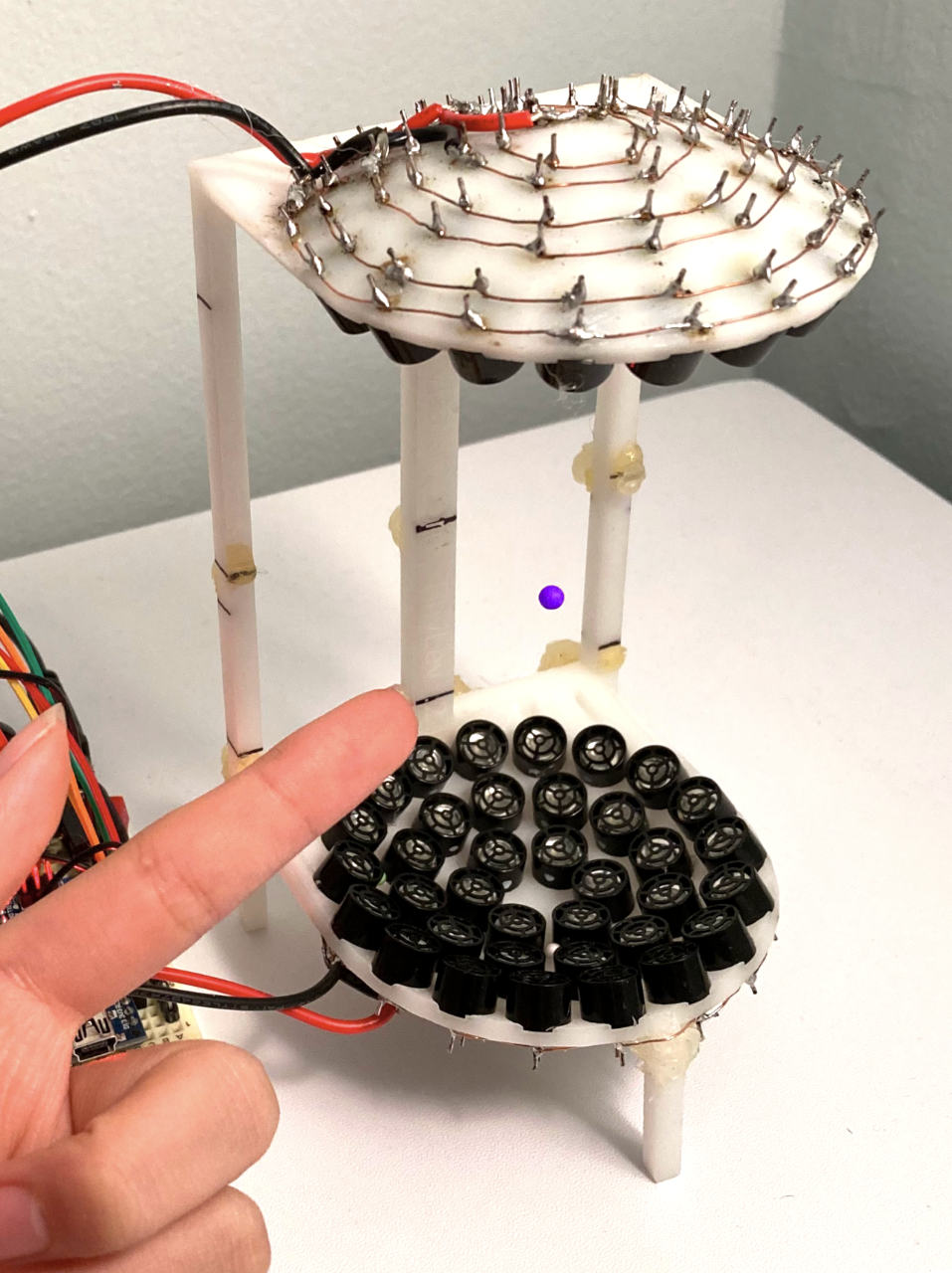
NYU physics researchers have observed a new type of time crystal—one whose particles levitate on a cushion of sound while interacting with each other by exchanging sound waves. Above, a bead (purple) is suspended in mid-air by sound waves emanating from (black) circular speakers arranged in a six-inch-tall 3D-printed frame. Image courtesy of NYU’s Center for Soft Matter Research
<関連情報>
- https://www.nyu.edu/about/news-publications/news/2026/february/scientists-discover–levitating–time-crystals-that-you-can-hold.html
- https://journals.aps.org/prl/abstract/10.1103/zjzk-t81n
非相反的な波動媒介相互作用が古典時間結晶の原動力となる Nonreciprocal Wave-Mediated Interactions Power a Classical Time Crystal
Mia C. Morrell, Leela Elliott, and David G. Grier
Physical Review Letters Published: 6 February, 2026
DOI: https://doi.org/10.1103/zjzk-t81n
Abstract
An acoustic standing wave acts as a lattice of evenly spaced potential energy wells for subwavelength-scale objects. Trapped particles interact with each other by exchanging waves that they scatter from the standing wave. Unless the particles have identical scattering properties, their wave-mediated interactions are nonreciprocal. Pairs of particles can use this nonreciprocity to harvest energy from the wave to sustain steady-state oscillations despite viscous drag and the absence of periodic driving. We show, in theory and experiment, that a minimal system composed of two acoustically levitated particles can access four distinct dynamical states, two of which are emergently active steady states. Under some circumstances, these emergently active steady states break spatiotemporal symmetry and therefore constitute a classical time crystal.