2026-01-16 中国科学院(CAS)
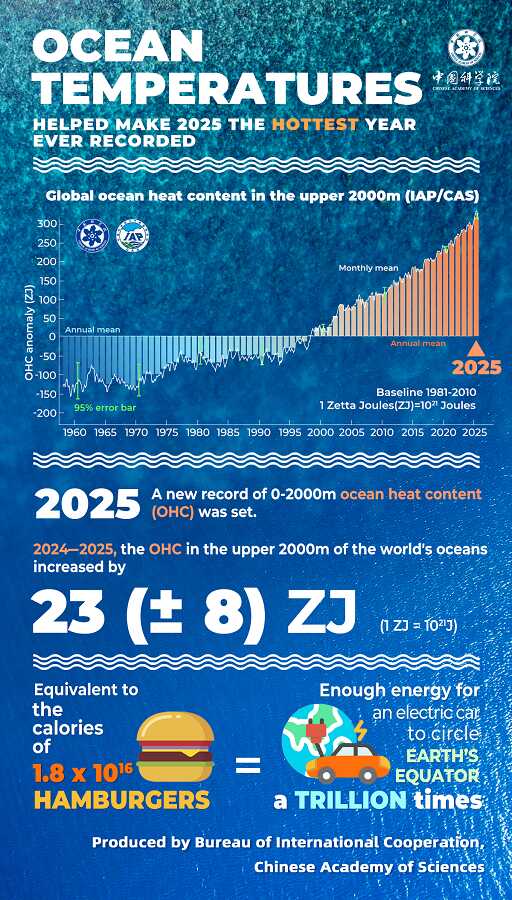
Global ocean heat content in 2025 compared with previous years. (Impage by Bureau of International Cooperation, Chinese Academy of Sciences)
<関連情報>
- https://english.cas.cn/newsroom/cas-in-media/202601/t20260119_1145825.shtml
- https://link.springer.com/article/10.1007/s00376-026-5876-0
海洋熱量は2025年に新たな記録を樹立 Ocean Heat Content Sets Another Record in 2025
Yuying Pan,Lijing Cheng,John Abraham,Kevin E. Trenberth,James Reagan,Juan Du,Zhankun Wang,Andrea Storto,Karina Von Schuckmann,Yujing Zhu,Michael E. Mann,Jiang Zhu,Fan Wang,Fujiang Yu,Ricardo Locarnini,John Fasullo,Boyin Huang,Garrett Graham,Xungang Yin,Viktor Gouretski,Fei Zheng,Yuanlong Li,Bin Zhang,Liying Wan,… Lin Chen
Advances in Atmospheric Sciences Published:09 January 2026
DOI:https://doi.org/10.1007/s00376-026-5876-0
Abstract
Global ocean warming continued unabated in 2025 in response to increased greenhouse gas concentrations and recent reductions in sulfate aerosols, reflecting the long-term accumulation of heat within the climate system, with conditions evolving toward La Niña during the year. In 2025, global upper 2000 m ocean heat content (OHC) increased by ∼23 ± 8 ZJ relative to 2024 according to IAP/CAS estimates. CIGAR-RT, and Copernicus Marine data confirm the continued ocean heat gain. Regionally, about 33% of the global ocean area ranked among its historical (1958–2025) top three warmest conditions, while about 57% fell within the top five, including the tropical and South Atlantic Ocean, Mediterranean Sea, North Indian Ocean, and Southern Oceans, underscoring the broad ocean warming across basins. Multiple datasets consistently indicate ocean warming, as measured by 0–2000 m OHC, increased from 0.14 ± 0.03 W m−2 (10 yr)−1 during 1960–2025 to 0.32 ± 0.14 W m−2 (10 yr)−1 during 2005–2025 (IAP/CAS), the latter being consistent with EEI (Earth’s Energy Imbalance) estimates within uncertainties. In contrast, the global annual mean sea surface temperature (SST) in 2025 was 0.49°C above the 1981–2010 baseline and 0.12 ± 0.03°C lower than in 2024 (IAP/CAS; similar in CMA-SST, FY3 MWRI SST, ERSSTv5 and Copernicus Marine data), consistent with the development of La Niña conditions, but still ranking as the third-warmest year on record.