2026-01-19 中国科学院(CAS)
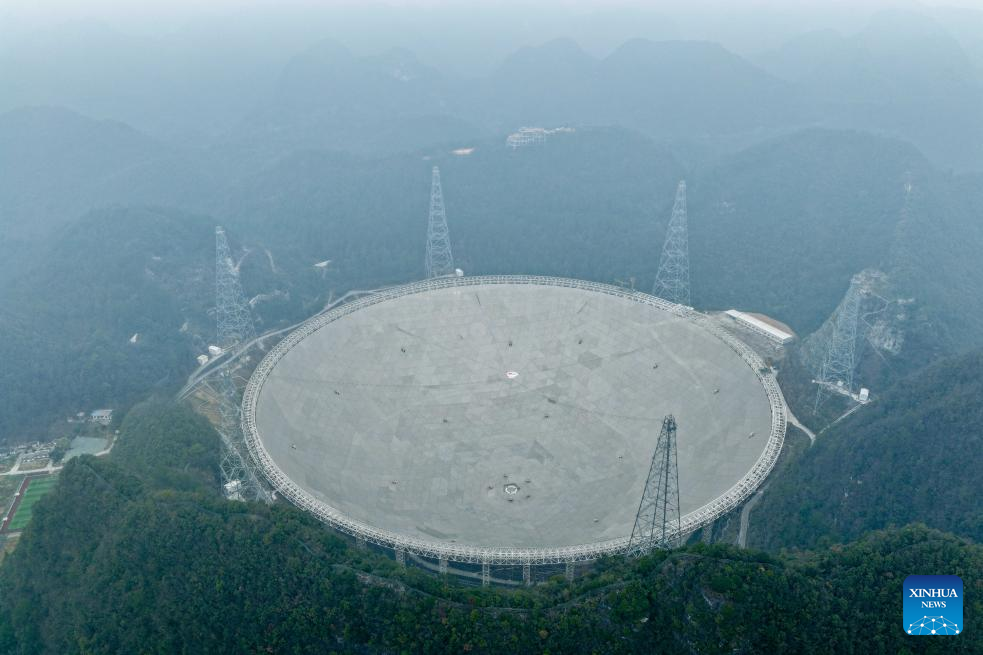
An aerial drone photo taken on Jan. 16, 2026 shows China’s Five-hundred-meter Aperture Spherical Radio Telescope (FAST) under maintenance in southwest China’s Guizhou Province. (Xinhua/Ou Dongqu)
<関連情報>
- https://english.cas.cn/newsroom/cas-in-media/202601/t20260119_1145866.shtml
- https://www.science.org/doi/10.1126/science.adq3225
繰り返される高速電波バーストの周囲の磁気環境の突然の変化と回復 A sudden change and recovery in the magnetic environment around a repeating fast radio burst
Y. Li, S. B. Zhang, Y. P. Yang, C. W. Tsai, […] , and B. Zhang
Science Published:15 Jan 2026
DOI:https://doi.org/10.1126/science.adq3225
Editor’s summary
Some fast radio bursts (FRBs) repeat at unpredictable intervals. The frequency and polarization properties of a FRB provide information about the plasma along the line of sight, including the environment near the FRB source. Li et al. monitored a repeating FRB for more than 2 years and identified its host galaxy. The polarization properties showed an abrupt change by orders of magnitude, which returned to normal after 2 weeks. The authors interpret this change as being due to dense plasma moving into the line of sight near the FRB source and discuss potential origins of the plasma. —Keith T. Smith
Abstract
Fast radio bursts (FRBs) are millisecond-duration radio transients from extragalactic sources. Some repeating FRBs exhibit variations in their Faraday rotation measure (RM) due to changes in their magneto-ionic environment. We report magneto-ionic variations of FRB 20220529, a repeating FRB from a disk galaxy at redshift 0.18. For the first 17 months of observations, the RM had a median of 17 radians per square meter (rad m−2) and a scatter of 101 rad m−2. In December 2023, the RM jumped to 1977 ± 84 rad m−2, then gradually returned to typical values within 2 weeks. This sudden RM variation indicates that a dense magnetized clump of plasma passed across the line of sight. We discuss potential explanations, including a coronal mass ejection from a companion star, high plasma turbulence, or binary orbital motion.