2026-01-16 ミシガン工科大学
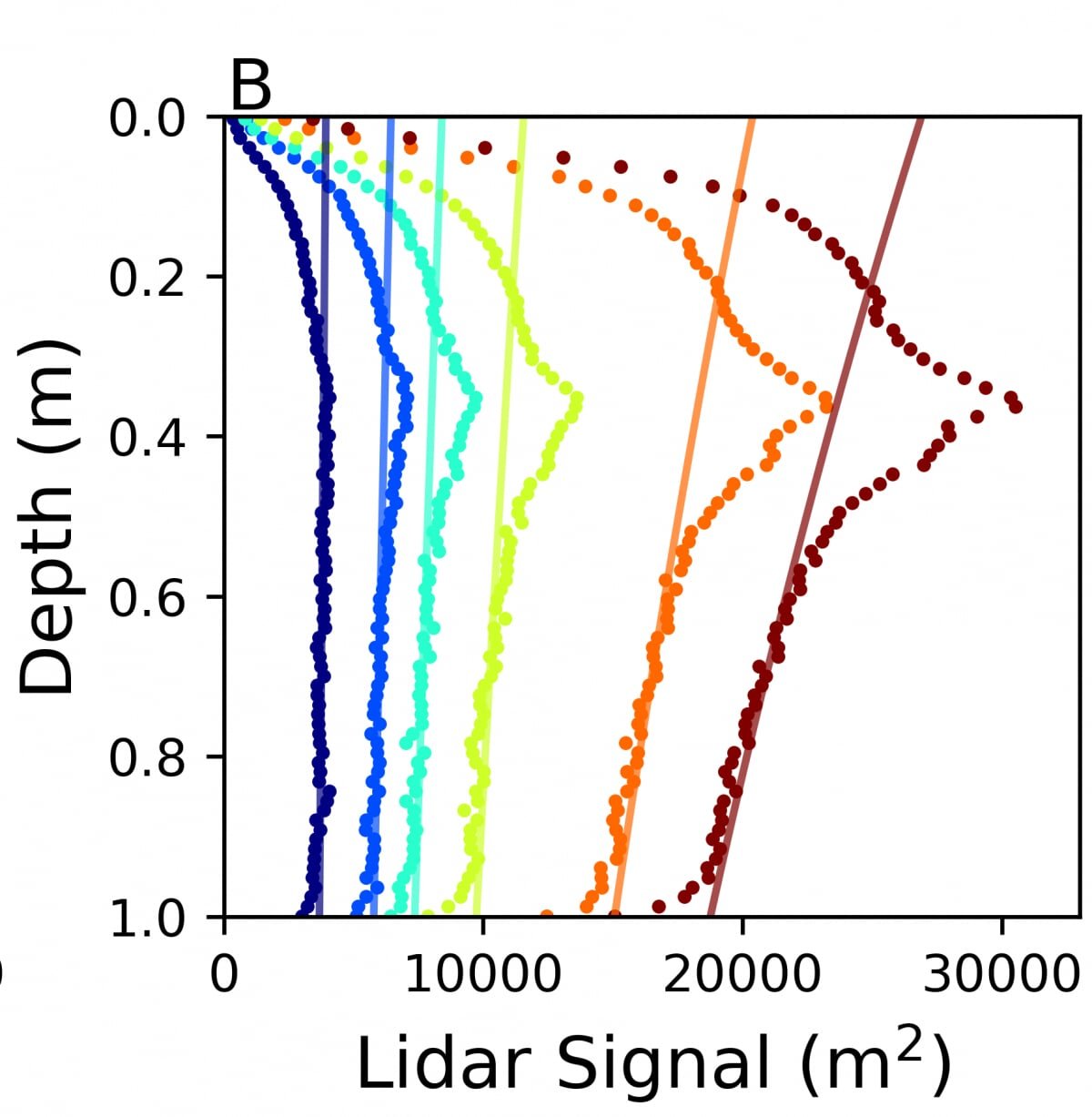
Key differences between observations and simulations. Data points on this graph represent corrected lidar signals at 1.2-centimeter resolution for different aerosol injection rates into the cloud chamber from low (blue) to high (red). For each injection rate, these measured signals vary significantly from the solid lines, which represent simulated lidar signals calculated under the assumption that the cloud is perfectly homogeneous in the chamber. The differences are most apparent in the uppermost region of the cloud. These fine-resolution measurements will improve understanding of cloud microphysical processes, particularly at the tops of clouds. (Image Courtesy Brookhaven National Laboratory)
<関連情報>
- https://www.mtu.edu/unscripted/2026/01/ultrahighresolution-lidar-reveals-hidden-cloud-structures.html
- https://www.pnas.org/doi/10.1073/pnas.2505421122
実験室雲頂付近における沈降誘起液滴サイズ選別の高解像度ライダー観測 High-resolution lidar observations of sedimentation-induced size sorting of droplets near a laboratory cloud top
Fan Yang, Yong Meng Sua, Zipei Zheng, +8 , and Raymond A. Shaw
Proceedings of the National Academy of Sciences Published:December 10, 2025
DOI:https://doi.org/10.1073/pnas.2505421122
Significance
Our understanding of cloud microphysical properties at centimeter scales remains incomplete because of limited observations. Here, high-resolution lidar observations of clouds in a convection chamber show that although the cloud is homogeneous in the bulk region, it is inhomogeneous at centimeter scales near the top. The topmost cloud layer is dominated by entrainment, diluting cloud droplets directly, below which is a transition region where droplet sedimentation causes a size-dependent reduction of droplet concentration. This sedimentation-induced size sorting of droplets occurs on scales smaller than those typically used in cloud-resolving models, and it can play a crucial role in cloud evolution and radiative properties.
Abstract
Cloud optical properties and precipitation, which are crucial to weather and climate, are strongly influenced by cloud microphysical properties that are still poorly understood. Here, we develop a high-resolution time-correlated single-photon-counting lidar and apply it to observe cloud microphysical properties at one-centimeter range resolution in a convection chamber under well-controlled conditions. Together with concurrent in-situ measurements and theoretical analysis, our lidar observations indicate that although turbulent mixing tends to homogenize the cloud in the bulk region, entrainment and sedimentation cause inhomogeneities in droplet concentrations near the cloud top. Specifically, the topmost region is directly affected by entrainment, and lidar profiles show clear evidence of entrained air and detrained cloud filament. The transition region below exhibits vertical size sorting of cloud droplets caused by sedimentation. Our results suggest that using a single sedimentation velocity for all cloud droplets, as is done in many atmospheric models, overlooks key physics relevant to the microphysical structure near the cloud top. Our conceptual model used to describe these measurements can serve as a step toward improving the current modeling of processes in the cloud top region.