
2026-01-06 アルゴンヌ国立研究所(ANL)
<関連情報>
- https://www.anl.gov/article/argonne-launches-silicon-quantum-processor-collaboration-with-intel
- https://www.nature.com/articles/s41467-025-67325-z
ゲルマニウムを含むシリコン量子井戸におけるバレー分割相関 Valley splitting correlations across a silicon quantum well containing germanium
Jonathan C. Marcks,Emily Eagen,Emma C. Brann,Merritt P. Losert,Talise Oh,J. Reily,Christopher S. Wang,Daniel Keith,Fahd A. Mohiyaddin,Florian Luthi,Matthew J. Curry,Jiefei Zhang,F. Joseph Heremans,Mark Friesen & M. A. Eriksson
Nature Communications Published:06 December 2025
DOI:https://doi.org/10.1038/s41467-025-67325-z
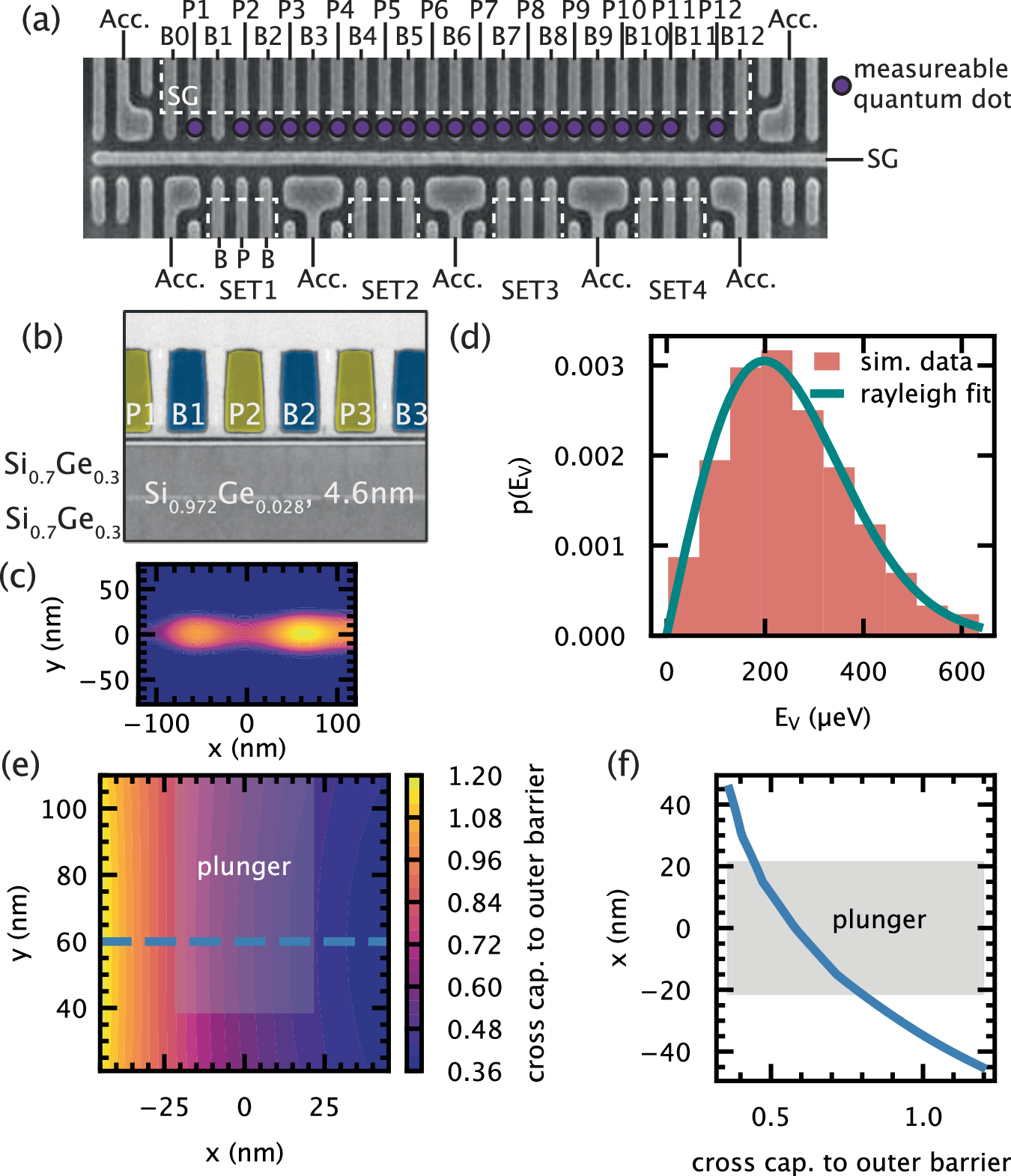
Abstract
Quantum dots in SiGe/Si/SiGe heterostructures host coherent electron spin qubits, which are promising for future quantum computers. The silicon quantum well hosts near-degenerate electron valley states, creating a low-lying excited state that is known to reduce spin qubit readout and control fidelity. The valley energy splitting is dominated by the microscopic disorder in the SiGe alloy and at the Si/SiGe interfaces, and while Si devices are compatible with large-scale semiconductor manufacturing, achieving a uniformly large valley splitting energy across a many-qubit device spanning mesoscopic distances is an outstanding challenge. In this work we study valley splitting variations in a 1D quantum dot array, formed in a Si0.972Ge0.028 quantum well, manufactured by Intel. We observe correlations in valley splitting, at both sub-100 nm (single gate) and > 1 μm (device) lengthscales, that are consistent with alloy disorder-dominated theory and simulation. Our results develop the mesoscopic understanding of Si/SiGe heterostructures necessary for scalable device design.


