2026-01-08 中国科学院(CAS)
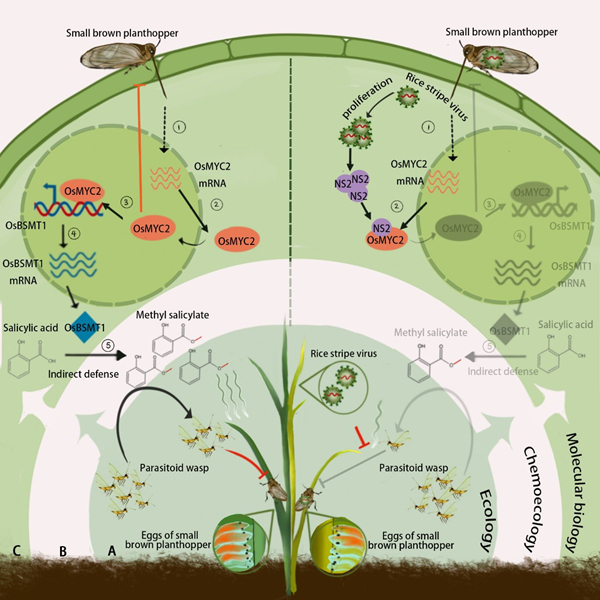
Proposed model illustrating how rice-infecting viruses attenuate indirect defenses against insect vectors. (Image by ZHANG Xiaoming’s Lab)
<関連情報>
- https://english.cas.cn/newsroom/research-news/202602/t20260210_1150310.shtml
- https://www.science.org/doi/10.1126/sciadv.aeb5215
アルボウイルスは稲の揮発性物質を操作し、畑の天敵から昆虫媒介生物を守る Arboviruses manipulate rice’s volatile emissions, protecting insect vectors from natural enemies in the field
Qing Liu, Qian Wang, Qiong Li, Weiran Wang, […] , and Xiaoming Zhang
Science Advances Published:7 Jan 2026
DOI:https://doi.org/10.1126/sciadv.aeb5215
Abstract
Vector-borne plant viruses depend on insect vectors for transmission and often suppress host defenses that limit vector survival and spread. However, their impact on volatile-mediated indirect defenses remains unclear. Here, we show that rice viruses inhibit methyl salicylate (MeSA) emission, impairing parasitoid recruitment and promoting vector persistence. Field experiments demonstrate that MeSA, a key herbivore-induced volatile, suppresses vector populations by attracting egg parasitoids. Viruses counter this by targeting basic-helix-loop-helix transcription factor OsMYC2, a jasmonic acid signaling hub, thereby down-regulating OsBSMT1 and MeSA biosynthesis, responses conserved across diverse rice viruses and vector species. MeSA applications in the field restore parasitoid-mediated vector suppression, highlighting its potential for sustainable disease control. MeSA is a central ecological signal in a previously unidentified viral strategy that enhances transmission.