
2025-12-22 カリフォルニア大学サンディエゴ校(UCSD)
<関連情報>
- https://today.ucsd.edu/story/how-climate-policies-that-incentivize-and-penalize-can-drive-the-clean-energy-transition
- https://www.nature.com/articles/s41558-025-02497-6
政策の順序付けがエネルギーの脱炭素化に与える影響のモデル化 Modelling the impacts of policy sequencing on energy decarbonization
Huilin Luo,Wei Peng,Allen Fawcett,Jessica F. Green,Gokul Iyer,Jonas Meckling,Jonas Nahm & David G. Victor
Nature Communications Published:22 December 2025
DOI:https://doi.org/10.1038/s41558-025-02497-6
Abstract
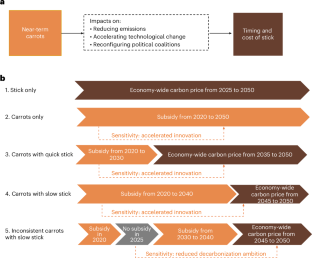
Many political jurisdictions have embraced climate policy strategies that emphasize large subsidies to deploy green technologies (‘carrots’) with the anticipation that more punitive policies (‘sticks’) may follow. However, little is known about how such policy sequencing affects future policies, emission reductions and costs. Using a multisector model for the USA, we examine carrot-first policies which mimic the increasingly popular interest in industrial policy and offer a way to model these real-world policy choices in energy-system models. We find that a carrot-first policy strategy still requires later use of similar-sized sticks when compared with a policy strategy that begins with sticks and achieves the same levels of long-term decarbonization. Policy carrots alone do not dramatically reduce future emissions. Only with policy sticks are there unambiguous signals to substantially shrink the size of incumbent fossil fuel industries.


