2025-12-01 中国科学院(CAS)
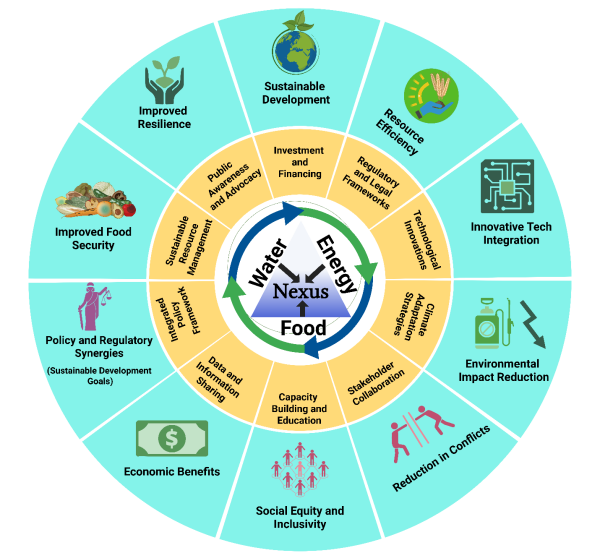
Integrated Water-Energy-Food Nexus framework illustrating key enablers and resulting benefits for sustainable agriculture and food security. (Image by XIEG)
<関連情報>
- https://english.cas.cn/newsroom/research_news/earth/202512/t20251203_1134426.shtml
- https://www.sciencedirect.com/science/article/abs/pii/S0308521X25003129
パキスタンの持続可能な農業のための水・エネルギー・食料ネクサスの最適化:世界的影響を伴うシステム分析 Optimizing the water-energy-food Nexus for sustainable agriculture in Pakistan: A systems analysis with global implications
Hassan Iqbal, Chen Yaning, Syed Turab Raza, Sona Karim
Agricultural Systems Available online: 22 November 2025
DOI:https://doi.org/10.1016/j.agsy.2025.104572
Highlights
- Pakistan’s agricultural productivity remains far below the global average.
- Productivity projected to rise 15.1 % by 2031 through input-intensive practices.
- Land use intensifies as water and energy resources show declining trends.
- Pesticide use may rise 82.25 %, posing environmental and health risks.
- WEF-nexus integration is vital for sustainable food and agricultural production.
Abstract
CONTEXT
Pakistan’s agricultural system, ranked among the world’s most water-stressed, demonstrates a critical resource utilization challenge. Despite a 21.8 % expansion in harvested area since 1991 and consuming 90 % of national freshwater resources, wheat productivity remains stagnant at half the global average. This disconnect between input use and output is further exacerbated by 50 % groundwater over-extraction, declining irrigation efficiency, and increasing reliance on chemical inputs. Collectively, these trends reveal the systemic fragility of input-driven growth and underscore the urgent need for an integrated water-energy-food (WEF) nexus approach to reconcile productivity with sustainability.
OBJECTIVE
This study has three key objectives: (1) quantify dynamic relationships between five critical agricultural inputs and productivity, (2) project sustainability thresholds under current practices, and (3) develop transferable optimization frameworks for water-scarce agricultural systems.
METHODS
We employ Autoregressive Distributed Lag (ARDL) cointegration analysis to examine long-term relationships and short-term dynamics between annual agricultural productivity (AAP) and five key inputs: agricultural water withdrawal (AWW), energy utilization (TEU), cultivated land area (THA), pesticide use (TPU), and fertilizer use (TFU) over a 30-year peroids (1991–2021). Additionally, Autoregressive Integrated Moving Average (ARIMA) forecasting models were employed to project future scenarios (2022−2031) for both inputs and AAP. The approach validates cointegration through rigorous diagnostic testing (ADF/PP, CUSUM), ensuring robust model performance for forecasting productivity (AAP) under varying input scenarios.
RESULTS AND CONCLUSIONS
The findings reveal unsustainable input trajectories: a projected 15.1 % increase in productivity by 2031 would require continued expansion of land (+21.8 % compared with 1991), pesticide use (+82.25 %) and fertilizer application (+19 %). Meanwhile agricultural water (−4.22 %) and energy availability (−6.15 %) are declining, highlighting that these critical resources are becoming increasingly limited. This combination of rising input demands and decreasing essential resources highlights the urgent need for policy interventions such as precision irrigation, integrated nutrient management, and pesticide regulation to avoid ecological collapse.
SIGNIFICANCE
This research provides the first quantitative framework demonstrating the infeasibility of area-expansion strategies in Pakistan’s agriculture. The findings call for immediate policy shifts toward precision irrigation, renewable energy integration, regulated agrochemical use and strengthened institutional coordination across water, energy, and agricultural sectors. The proposed WEF nexus framework offers scalable, evidence-based solutions for improving resource efficiency and food security in Pakistan and other semi-arid regions globally.