
2025-12-08 コロンビア大学
<関連情報>
- https://www.engineering.columbia.edu/about/news/silicon-chips-brain-researchers-announce-new-generation-brain-computer-interface
- https://www.nature.com/articles/s41928-025-01509-9
65,536個の電極と1,024個のチャンネルを備えたワイヤレス硬膜下脳コンピューターインターフェース A wireless subdural-contained brain–computer interface with 65,536 electrodes and 1,024 channels
Taesung Jung,Nanyu Zeng,Jason D. Fabbri,Guy Eichler,Zhe Li,Erfan Zabeh,Anup Das,Konstantin Willeke,Katie E. Wingel,Agrita Dubey,Rizwan Huq,Mohit Sharma,Yaoxing Hu,Girish Ramakrishnan,Kevin Tien,Paolo Mantovani,Abhinav Parihar,Heyu Yin,Denise Oswalt,Alexander Misdorp,Ilke Uguz,Tori Shinn,Gabrielle J. Rodriguez,Cate Nealley,… Kenneth L. Shepard
Nature Electronics Published:08 December 2025
DOI:https://doi.org/10.1038/s41928-025-01509-9
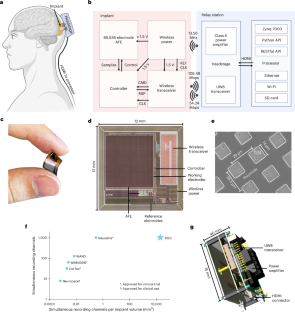
Abstract
Electrocorticography uses non-penetrating electrodes embedded in flexible substrates to record electrical activity from the surface of the brain. To use the technology to develop minimally invasive, high-bandwidth brain–computer interfaces, it will be necessary to improve the number of recording channels and the scalability of devices, which could be achieved by merging electrodes and electronics onto a single substrate. Here we report a 50-μm-thick, mechanically flexible micro-electrocorticography brain–computer interface that integrates a 256 × 256 array of electrodes, signal processing, data telemetry and wireless powering on a single complementary metal–oxide–semiconductor substrate. The device contains 65,536 recording electrodes, from which we can simultaneously record a selectable subset of up to 1,024 channels at a given time. Our chip is wirelessly powered, and when implanted below the dura, it can communicate bidirectionally with an external relay station outside the body. We show that the device can provide chronic, reliable recordings for up to two weeks in pigs and up to two months in behaving non-human primates from the somatosensory, motor and visual cortices, decoding brain signals at high spatiotemporal resolution.

