
2025-12-05 デラウェア大学(UD)
<関連情報>
- https://www.udel.edu/udaily/2025/december/reversible-conductive-hydrogel-bioelectronics/
- https://www.nature.com/articles/s41467-025-66034-x
自己組織化導電性高分子コロイドの熱可逆ゲル化 Thermo-reversible gelation of self-assembled conducting polymer colloids
Vidhika S. Damani,Xinran Xie,Rachel E. Daso,Khushboo Suman,Masoud Ghasemi,Weiran Xie,Ruiheng Wu,Yuhang Wu,Calvin L. Chao,Julian E. Alberto,Casey M. Lorch,Ai-Nin Yang,Dan My Nguyen,Tulaja Shrestha,Kayla Otero,Chun-Yuan Lo,Darrin J. Pochan,Enrique D. Gomez,Jonathan Rivnay & Laure V. Kayser
Nature Communications Published:05 December 2025
DOI:https://doi.org/10.1038/s41467-025-66034-x
Abstract
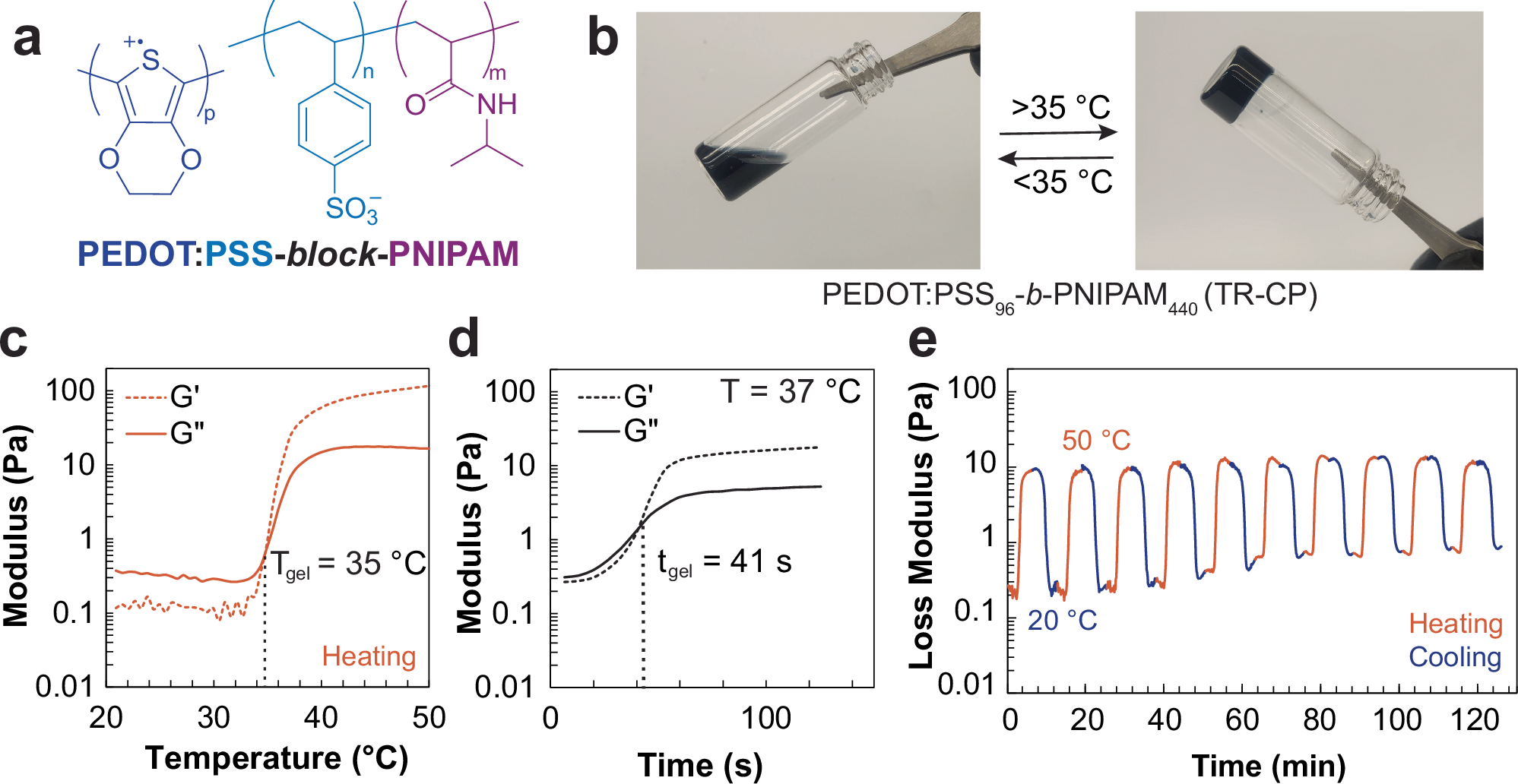
Electrically conductive hydrogels based on conducting polymers have found increased use in bioelectronics due to their low moduli that mimic biological tissues, their ability to transport both ionic and electronic charges, and their ease of processing in various form factors via printing or injection. Current approaches towards conductive hydrogels, however, rely on covalent and therefore irreversible crosslinking mechanisms. Here, we report a thermo-responsive conducting polymer (TR-CP) that undergoes a fully reversible non-covalent crosslinking at 35 °C within less than a minute to form conductive hydrogels. The TR-CP is based on a block polyelectrolyte complex, that self-assembles into well-defined colloidal particles in water which undergo an isovolumetric sol-gel transition just below physiological temperature. The hydrogels have tunable mechanical properties in the 20 to 200 Pa range, are stable at various pH and salt conditions, self-healing, injectable, and biocompatible in vitro and in vivo. We demonstrate that the TR-CPs can be used to fabricate sensitive, conformal and reusable electrodes for surface electromyography. This thermo-responsive material provides exciting opportunities for stimuli-responsive and adaptive bioelectronics.


