2025-12-04 パシフィック・ノースウェスト国立研究所(PNNL)
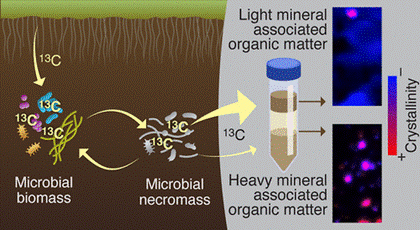
Where microbes live and die has a strong impact on soil health across agricultural landscapes. Noncrystalline mineral surfaces can bind microbial residues to build soil organic matter. (Graphic by Nathan Johnson | Pacific Northwest National Laboratory)
<関連情報>
- https://www.pnnl.gov/publications/microbial-residues-last-longer-soil-when-bound-noncrystalline-minerals
- https://pubs.acs.org/doi/10.1021/acs.est.5c01482
微生物と鉱物の相互作用によって制御される土壌微生物壊死体の蓄積 Accumulation of Soil Microbial Necromass Controlled by Microbe–Mineral Interactions
Qian Zhao,Sheryl Bell,Ravi Kukkadapu,Jocelyn Richardson,John Cliff,Mark Bowden,Sarah Leichty,and Kirsten S. Hofmockel
Environmental Science & Technology Published: July 24, 2025
DOI:https://doi.org/10.1021/acs.est.5c01482
Abstract
Soil organic matter (SOM) is a key reservoir for global carbon (C), supporting soil fertility and influencing greenhouse gas emissions. Microbial residues, composed of dead cells and cellular fragments, are major contributors to SOM formation. Yet, mechanisms by which minerals enhance the accumulation of microbial residues remain poorly understood. Here, we used 13C-labeled glucose in a year-long incubation to trace microbial residue in sandy and silty soils. Across both soils, approximately 89% of retained microbial 13C was recovered in the fine (<53 μm) mineral-associated organic matter (MAOM) pool. Within this pool, the light MAOM fraction, enriched in poorly crystalline Fe minerals, held 4.3 times more 13C than the heavy, phyllosilicate-dominated MAOM fraction, despite accounting for only 17.2% of the total MAOM mass and 12.3% of the total soil mass. Along with 13C enrichment, the light MAOM fraction showed greater abundance of N-containing groups, e.g., (amides and amino groups), indicative of microbial-derived compounds like proteins and amino sugars. Fe oxides in light MAOM from both soils were spatially dispersed. Microbial residue accumulation was greater in finer-textured silty soil. These findings demonstrate that mineral composition and texture jointly regulate microbial necromass accrual, highlighting light MAOM as a key pool for enhancing soil C storage.