2025-12-01 シカゴ大学(UChicago)
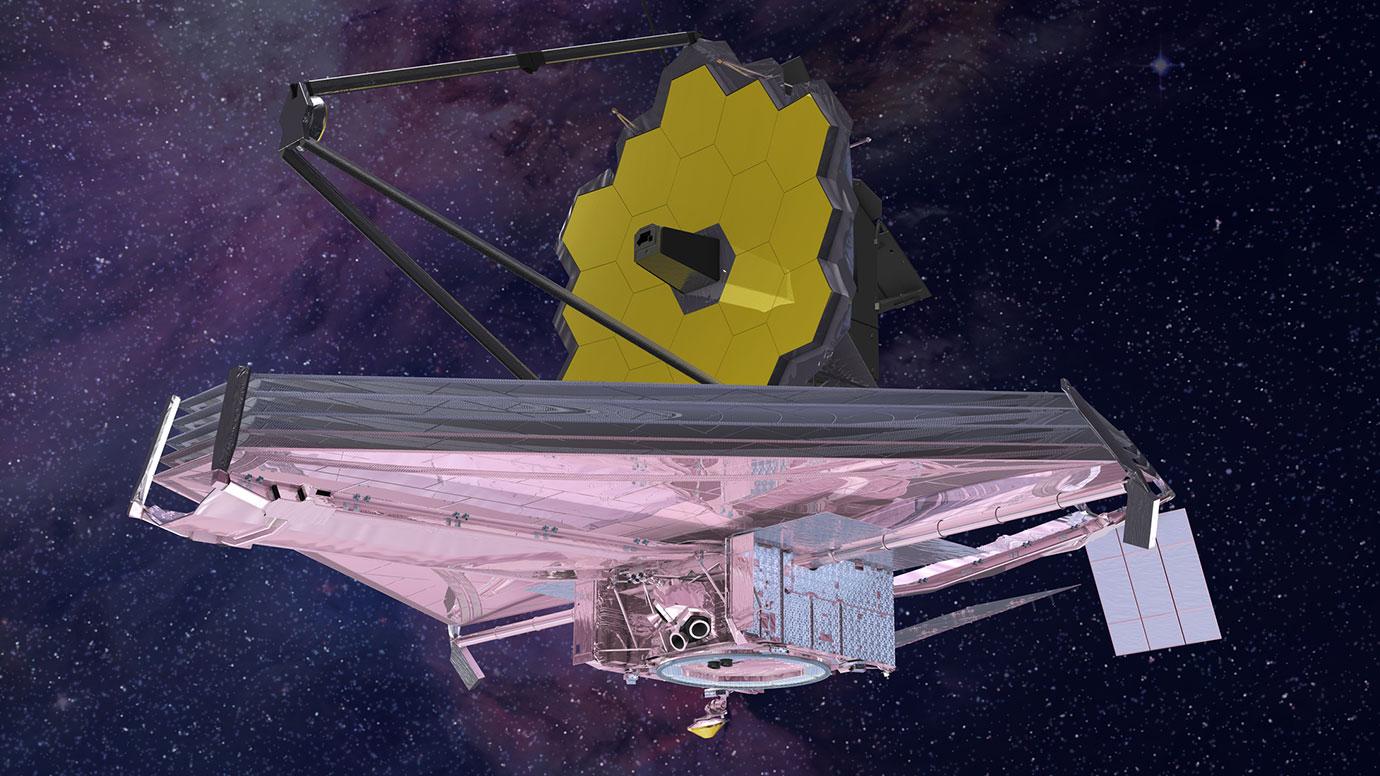
The James Webb Space Telescope, launched in 2021 as the successor to the Hubble Telescope, has already given us unprecedented views into the worlds around other stars. It has special instruments designed for exoplanet observations, and its position in space allows it to see in certain wavelengths that Earth’s atmosphere normally blocks.Image courtesy of NASA, ESA, CSA, Northrop Grumman
<関連情報>
- https://news.uchicago.edu/story/webb-telescope-captures-exoplanet-dramatically-shedding-its-atmosphere-real-time
- https://www.nature.com/articles/s41550-025-02710-8
WASP-107 bの前縁と後縁の両方から連続的にヘリウムが吸収される Continuous helium absorption from both the leading and trailing tails of WASP-107 b
Vigneshwaran Krishnamurthy,Yann Carteret,Caroline Piaulet-Ghorayeb,Jared Splinter,Dhvani Doshi,Michael Radica,Louis-Philippe Coulombe,Romain Allart,Vincent Bourrier,Nicolas B. Cowan,René Doyon,David Lafrenière,Loïc Albert,Björn Benneke,Lisa Dang,Ray Jayawardhana,Doug Johnstone,Lisa Kaltenegger,Adam B. Langeveld,Stefan Pelletier,Jason F. Rowe,Pierre-Alexis Roy,Jake Taylor & Jake D. Turner
Nature Astronomy Published:01 December 2025
DOI:https://doi.org/10.1038/s41550-025-02710-8
Abstract
The formation and evolution of giant planets remain incompletely understood, with mounting evidence that many close-in giants may have migrated from their birth locations. The detection of helium escaping the atmosphere of exoplanets has provided a powerful new tracer of atmospheric escape and exoplanetary evolution. Here, using high-precision spectroscopic observations from the James Webb Space Telescope (JWST) Near Infrared Imager and Slitless Spectrograph (NIRISS) in single-object slitless spectroscopy mode (SOSS) mode, we report the detection of substantial helium absorption during the pre-transit phase of WASP-107 b (17σ), as well as in the transit and post-transit phases. This unique continuous helium absorption begins approximately 1.5 h before the planet’s ingress and reveals the presence of an extended thermosphere. The observations show a maximum transit depth of 2.395 ± 0.01% near the helium triplet (36σ; at the NIRISS-SOSS resolution of ~700). Our ellipsoidal model of the planetary thermosphere matches the measured light curve well, suggesting an outflow extending to tens of planetary radii. Furthermore, we confidently detect water absorption (log10H2O = −2.5 ± 0.6), superimposed with a short-wavelength slope that we attribute to a prominent signature from unocculted stellar spots (5.2σ), rather than a small-particle haze slope. We place an upper limit on the abundance of K (log10K < −4.86, or K/H < 75× stellar) at 2σ, which is consistent with the O/H supersolar metallicity estimate. Together with the supersolar water abundance and the evidence for vigorous atmospheric escape, these findings suggest that WASP-107 b has undergone inward migration in its recent past, probably accompanied by strong tidal heating that continues to sustain its inflated atmosphere and mass loss. This investigation underscores the transformative potential of JWST for investigating planetary evolution.