2025-12-01 ミュンヘン大学(LMU)
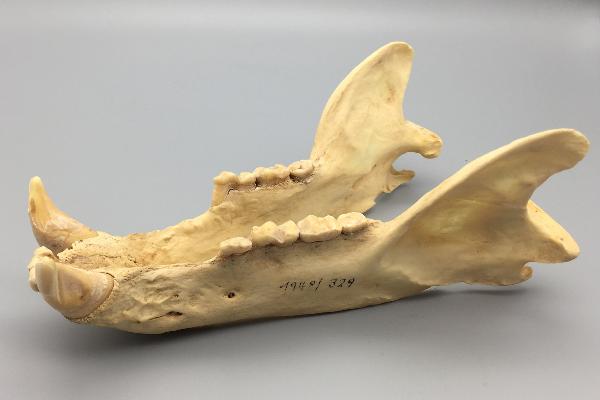
Lower jaw of a polar bear
The polar bear has a second molar that is only slightly larger than the first. Although the polar bear is a carnivore, it is descended from the omnivorous brown bear.© Katja Henßel, SNSB
<関連情報>
- https://www.lmu.de/en/newsroom/news-overview/news/bear-teeth-break-free-researchers-discover-the-origin-of-unusual-bear-dentition.html
- https://onlinelibrary.wiley.com/doi/10.1111/bor.70044
化石クマは、食餌適応によって引き起こされた抑制カスケードの制約から少なくとも2回(Ursus minimusとUrsus deningeri )解放された Fossil bears break free from inhibitory cascade constraints at least twice (Ursus minimus and Ursus deningeri) caused by dietary adaptations
Anneke H. van Heteren, A. Stefanie Luft
Boreas Published: 26 November 2025
DOI:https://doi.org/10.1111/bor.70044
Abstract
The inhibitory cascade model (ICM) predicts relative mammalian molar size and shows a relationship between relative molar size and diet. Bears do not follow the ICM. The aims of this study are to determine which bears, if any, adhere to the ICM, and to assess the evolution of dental development in bears to determine when and why their developmental pattern changed. Molars were measured with sliding callipers and occlusal surface area was taken as a proxy for molar size. An ICM morphospace was created with relative m2 and m3 size on the x– and y-axes, respectively. Our findings indicate that there are two deviations from the ICM. The first takes place between Ursus boeckhi and Ursus minimus and is attributed to a reduction in inhibitors in m1. We suggest the term ‘partial ICM’ to describe the developmental pattern of bears following the first deviation, as their distribution in morphospace runs parallel to the ICM yet is shifted towards a disproportionately larger m2 associated with increased omnivory. The second break takes place between Ursus minimus and Ursus deningeri and is caused by a reduction in inhibitors in m2 resulting in a shift towards disproportionately larger m3 associated with increased herbivory. The two breaks in the established developmental pattern of the ICM are linked to dietary adaptations that can be traced to environmental change, showing the effects of the environment on development on evolutionary time scales.