
2025-11-21 パシフィック・ノースウェスト国立研究所(PNNL)
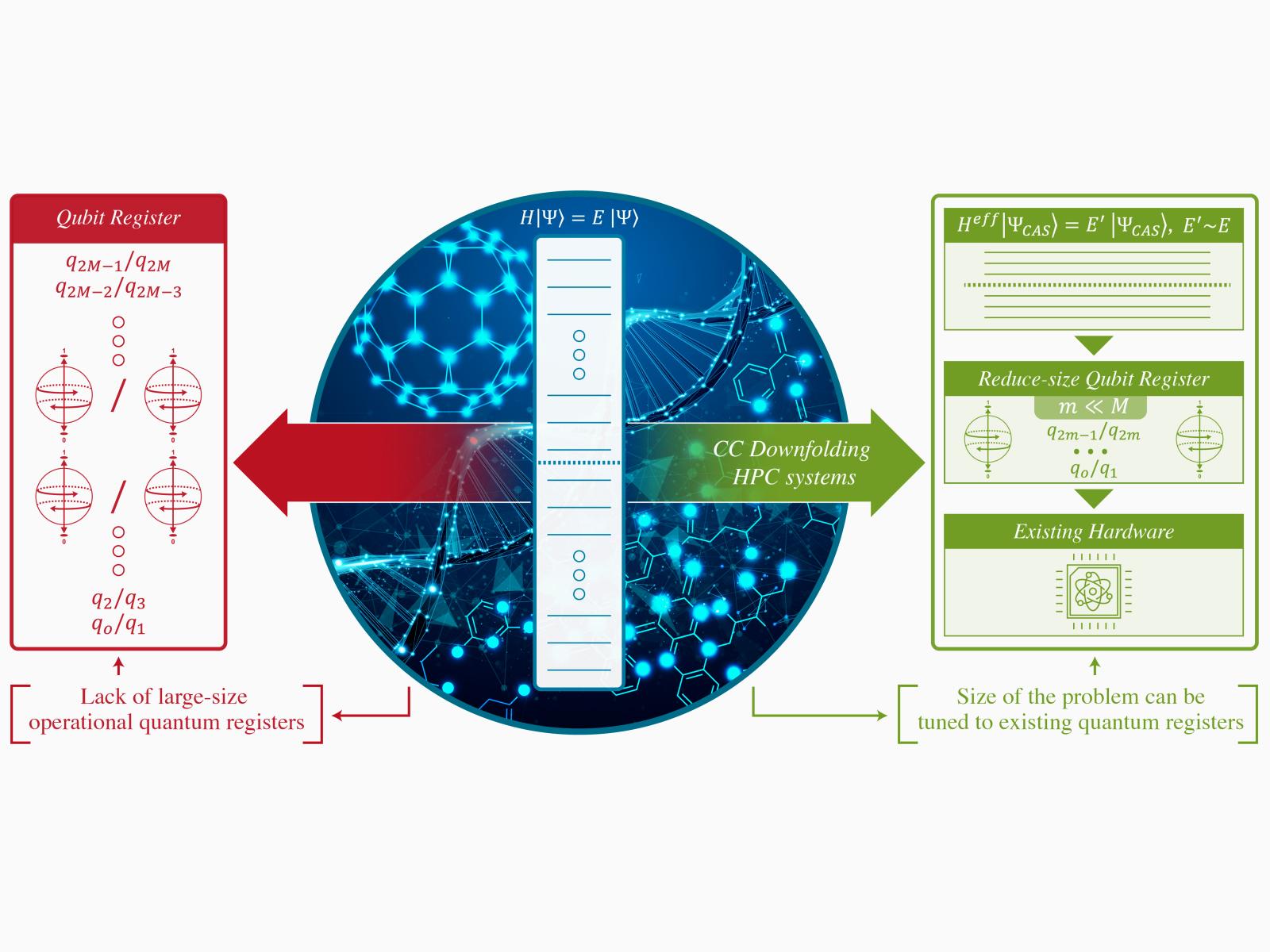
A new approach to simulating the ground states of molecular electronic systems showed increased accuracy compared to more traditional simulation approaches without increasing the load on a quantum computer.(Image by Cortland Johnson | Pacific Northwest National Laboratory)
<関連情報>
- https://www.pnnl.gov/publications/increasing-simulation-accuracy-quantum-computing
- https://pubs.acs.org/doi/full/10.1021/acs.jctc.5c00896
ADAPT変分量子固有値ソルバーと二重ユニタリーダウンフォールディングによる量子ビット効率の高い量子化学 Qubit-Efficient Quantum Chemistry with the ADAPT Variational Quantum Eigensolver and Double Unitary Downfolding
Harjeet Singh,Luke W. Bertels,Daniel Claudino,Sophia E. Economou,Edwin Barnes,Nicholas P. Bauman,Karol Kowalski,and Nicholas J. Mayhall
Journal of Chemical Theory and Computation Published: September 4, 2025
DOI:https://doi.org/10.1021/acs.jctc.5c00896
Abstract
In this work, we combine the recently developed double unitary coupled cluster (DUCC) theory with the adaptive, problem-tailored variational quantum eigensolver (ADAPT-VQE) to explore the accuracy of unitary downfolded Hamiltonians for quantum simulation of chemistry. We benchmark the ability of DUCC effective Hamiltonians to recover dynamical correlation energy outside of an active space. We consider the effects of strong correlation, commutator truncation, higher-body terms, and approximate external amplitudes on the accuracy of these effective Hamiltonians. When combining these DUCC Hamiltonians with ADAPT-VQE, we observe similar convergence of the ground state as compared with bare active space Hamiltonians, demonstrating that DUCC Hamiltonians provide increased accuracy without increasing the load on the quantum processor.



